The Seven Brothers and the Stitched Path to Punta Pinal
How One Pioneer Family Carried Their World South into an Untamed Florida
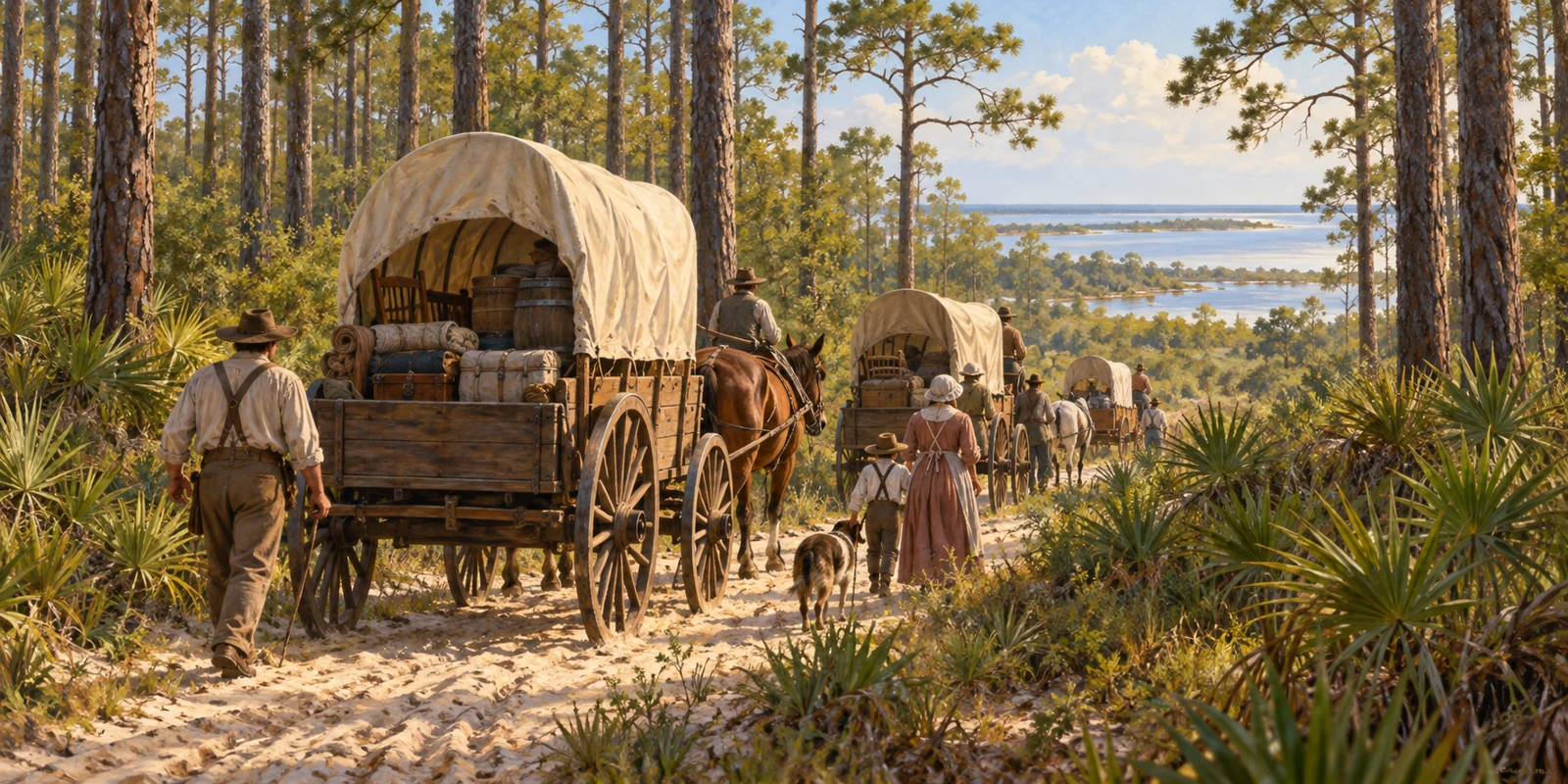
Somewhere south of the Georgia pinelands, a column of wagons rolled toward a horizon that most men of their era had never dared approach. The road, such as it was, narrowed to little more than a rutted trace pressed into the clay and sand by decades of cattle drovers, Seminole trading parties, and military patrols.
According to the historical record passed down through generations of their descendants, seven brothers made that journey. Their surname was McMullen. They had come out of the general South Georgia country — the red-clay cattle and farming country near present-day Quitman, Georgia and Madison County, Florida — and they were pointed south toward a destination known by its Spanish name: Punta Pinal, the Point of Pines.
Their story is preserved in the accounts of their descendants, in land grant records, in the names still scattered across the Pinellas Peninsula map, and in the work of historians who have documented it in peer-reviewed scholarship.
Seven Brothers, One Direction
The McMullen brothers came of a Scots-Irish stock that had filtered southward through the Carolinas and Georgia over generations. Historians who have studied the family's origins document that James Jr. and Rebecca Fain McMullen raised twelve children together — seven sons and five daughters — in the farming country of South Georgia near Quitman.
The historical record of the McMullen descendants describes seven brothers making the southward migration, though the precise sequence of their departures and the exact years each traveled may have varied. What the record preserves consistently is the direction of their movement and its destination: the Pinellas Peninsula.
Into the Green Wilderness
Frontier Florida in the early-to-mid 1800s was dominated by ecosystems of staggering scale. Longleaf pine forests, oak hammocks, river swamps, cypress heads, palmetto prairies, blackwater rivers, and coastal bays formed a landscape that demanded constant adaptation from the families who entered it.
The Point of Pines
For the McMullen brothers, the destination was Punta Pinal — a place whose Spanish name evoked the longleaf pines that stood watch over shell-strewn shores. The Pinellas Peninsula juts southward between Tampa Bay and the Gulf of Mexico, opening onto a bay system of extraordinary richness.
Why Their Stories Matter
The significance of the McMullen family's migration extends well beyond genealogical interest. It represents, in concentrated form, the experience of thousands of Florida pioneer families who staked their futures on a landscape that offered equal measures of abundance and hardship.
Sources & Further Reading
- Harris, Robert C. “The Seven McMullen Brothers of Pinellas County.” Tampa Bay History, Vol. 1, Issue 2, 1979.
- Ivey, Donald J. “The Accidental Pioneer: Capt. Jim McMullen and the Taming of the Pinellas Peninsula.” Sunland Tribune, Vol. 22, 1996.
- Heritage Village of Pinellas County. Daniel McMullen House historical marker.
- Florida Memory, State Library and Archives of Florida.