
Construction Begins on Castillo de San Marcos
October 2, 1672 — Spanish officials break ground for a permanent stone defense at St. Augustine.
By Wm. E. McMullen II
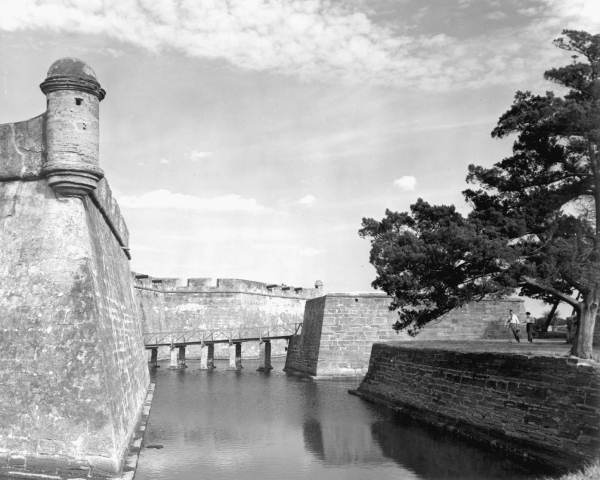
On the afternoon of October 2, 1672, Governor Manuel de Cendoya and other Spanish officials raised their shovels and began the foundation trenches for Castillo de San Marcos. St. Augustine had existed for more than a century, but its defenses had repeatedly been built of wood. Spain was finally committing to stone.
Why St. Augustine Needed a Stronger Fort
Wooden forts rotted, burned and suffered from insects, storms and tides. The danger became impossible to ignore after English privateer Robert Searle raided St. Augustine in 1668, killing residents, looting the town and demonstrating how vulnerable Spain's Florida capital remained. England's establishment of Charles Towne in 1670 added a growing imperial rival just up the coast.
The Spanish crown authorized a permanent fortification. Cendoya arrived as governor in 1671, and engineer Ignacio Daza came from Havana the following year to design the work.
Building with Coquina
The builders turned to coquina, a local stone made from compressed shell fragments. Workers quarried it on Anastasia Island, cut it into blocks, moved it by wagon and raft, and assembled massive walls on the western shore of Matanzas Bay.
Coquina proved unusually effective. Instead of shattering like harder stone when struck by cannon fire, its porous mass could absorb impact. The material became part of the fortress's identity and one reason the structure survived attacks that destroyed much of the surrounding town.
Who Did the Work
The Castillo was not created by governors and engineers alone. According to the National Park Service, Guale, Timucua and Apalache people formed the largest part of the labor force and were compelled to travel and work for the Spanish crown. Records say they were paid and fed, but they also describe coercion, delayed service and mistreatment. Native families bore costs when men were kept far from home.
Spanish artisans, soldiers, convicts and Africans—both free and enslaved—also contributed. Remembering these workers changes the monument from a simple military landmark into evidence of the many lives and unequal systems that built colonial Florida.
A Twenty-Three-Year Project
Cendoya and Daza both died within months of the groundbreaking. Six governors then carried the work through changing plans, shortages, epidemics, storms and financial trouble. The fortress was declared finished in 1695. It later survived English sieges in 1702 and 1740 and changed names and flags as Florida passed among Spain, Britain and the United States.
Why It Matters
The October 2 groundbreaking marks the beginning of Florida's most enduring colonial structure. The Castillo protected Spain's hold on St. Augustine and guarded a strategic route along the Atlantic coast.
Its survival also lets visitors encounter seventeenth-century choices in physical form: the fear of imperial rivals, the adaptation of local materials and the labor demanded from Native, African and European people. The walls are impressive, but the full story includes everyone who quarried, hauled and placed the stone.
Sources for Additional Reading
- National Park Service — Who Built the Castillo?
- National Park Service — The First Spanish Period, 1565–1763
- Florida Memory — Castillo de San Marcos, PR09530
Explore the daily archive: Discover more events that shaped Florida's communities, culture and history.
Today in Florida History