Florida Learning HubBefore There Were Highways and Subdivisions
New from Florida Learning Hub

Florida Learning Hub Classroom Resources

Practical learning tools created for classrooms, homeschool families, and curious students. Our growing collection of guided journals and instructional workbooks helps students read, write, research, investigate, observe, design, and discover.

Explore. Learn. Discover. The Real Florida.

Learning Tools Built for Students

Florida Learning Hub Classroom Resources are designed to be used—not simply read. The collection includes primary-grade journals and more advanced guided workbooks for elementary and middle-grade learners. Explore the published titles below and follow each book’s Amazon link for available editions.

Reading, Writing & Research

Build Stronger Readers, Writers & Researchers

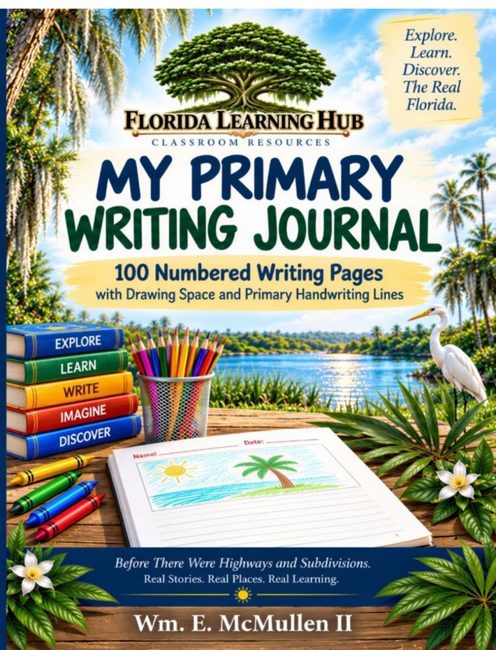
Cover of My Primary Writing Journal

My Primary Writing Journal

Book Description

Give young writers a place for both their words and their imagination.

My Primary Writing Journal includes 100 numbered writing pages designed for primary students. Each writing page provides a large blank space for drawing and illustration along with primary handwriting lines for student writing.

Numbered pages make classroom organization easier for teachers and help students keep their work in order—without teachers having to hand-number an entire classroom set of journals.

Ideal for daily writing, creative writing, journal prompts, story development, science observations, social studies responses, classroom reflections, and illustrated writing assignments.

Features include:

  • 100 numbered writing pages
  • Drawing and illustration space
  • Primary handwriting lines
  • Large 8.5 × 11 inch format
  • Designed for classroom and individual student use

Part of the Florida Learning Hub Classroom Resources series.

Explore. Learn. Discover. The Real Florida.
See the Book on Amazon
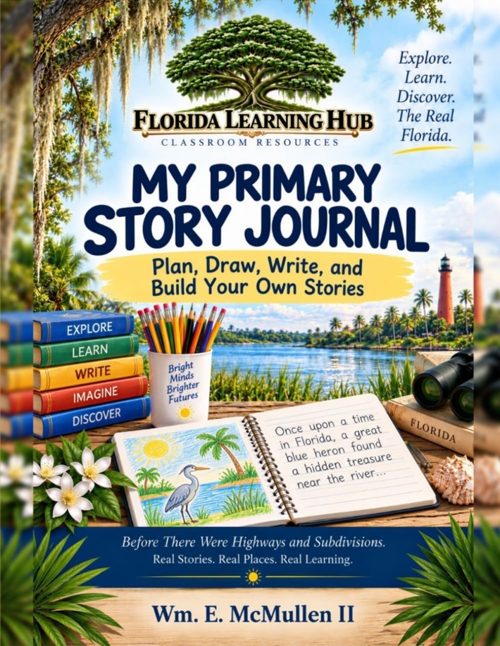
Cover of My Primary Story Journal

My Primary Story Journal

Book Description

Give young writers a place to plan, imagine, draw, and create their own stories.

My Primary Story Journal guides elementary students through the story-writing process with 20 complete story-building cycles. Rather than simply providing blank writing pages, each story begins with planning and sequencing activities that help young writers organize their ideas before they begin writing.

Each story guides students through identifying characters, setting, and a problem or goal, then planning what happens in the beginning, middle, and end. Students have a full page to illustrate an important scene followed by two pages of primary writing lines for developing their finished story.

The simple, repeatable format helps students practice narrative writing while building creativity, organization, confidence, and independent writing skills.

Each of the 20 story cycles includes:

  • Plan My Story page
  • Characters, setting, and problem or goal
  • Beginning, middle, and end story planning
  • Full-page drawing and illustration space
  • Two primary-lined story-writing pages
  • Prompts encouraging details, sequencing, and strong endings
  • Large 8.5 × 11 inch format

Ideal for Grades 2–5, classroom writing centers, homeschool language arts, independent writing, creative-writing practice, and young authors.

The story-building structure supports elementary narrative-writing skills, including skills emphasized in Florida’s B.E.S.T. English Language Arts standards, while remaining useful with any curriculum.

Part of the Florida Learning Hub Classroom Resources series.

Explore. Learn. Discover. The Real Florida.
See the Book on Amazon
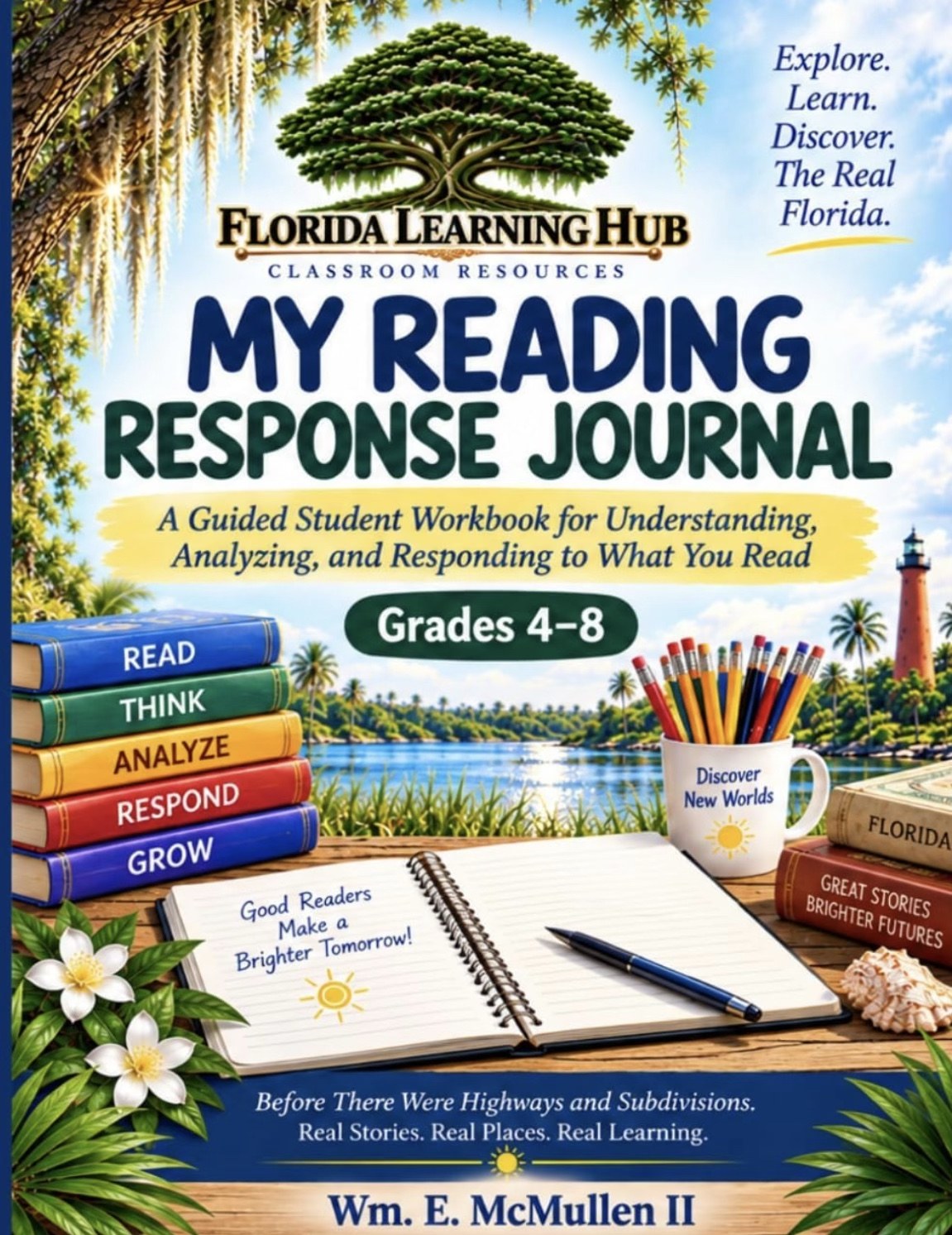
Cover of My Reading Response Journal

My Reading Response Journal

Book Description

Build stronger readers by helping students move beyond simply finishing a text to understanding, analyzing, and responding to what they read.

My Reading Response Journal is a guided student workbook for Grades 4–8 designed for use with both fiction and nonfiction.

Students learn and practice essential reading skills including close reading, identifying main ideas and supporting details, determining theme, making inferences, using text evidence, analyzing characters, examining author's purpose and point of view, understanding vocabulary in context, recognizing text structure, summarizing accurately, comparing texts, and developing evidence-based written responses.

Instructional pages explain important reading concepts and provide examples before students apply the skills themselves. Reusable response pages provide ample writing space for students to develop increasingly thoughtful answers based on what they have read.

The journal also includes fiction and nonfiction reading responses, text-comparison activities, Claim-Evidence-Reasoning practice, constructed and extended-response planning, independent reading records, reading goals, conference notes, and student reflections.

Designed for classrooms, homeschool programs, independent reading, literature circles, intervention and enrichment, science and social studies reading, and cross-curricular literacy instruction.

Grades 4–8

Part of the Florida Learning Hub Classroom Resources series.

Explore. Learn. Discover. The Real Florida.
See the Book on Amazon
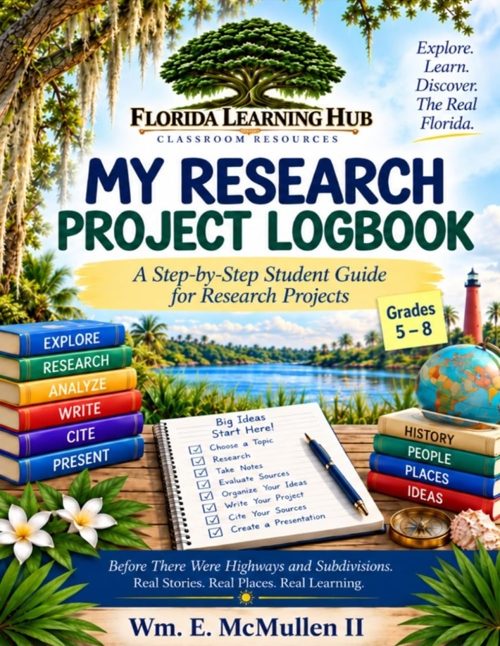
Cover of My Research Project Logbook

My Research Project Logbook

Book Description

Turn a research assignment into an organized journey from the first idea to the final presentation.

My Research Project Logbook is a step-by-step research guide and working journal designed for students in Grades 5–8. It gives young researchers one place to choose a topic, develop a focused question, find and evaluate sources, take organized notes, verify information, build citations, develop conclusions, and prepare a finished project or presentation.

Rather than simply collecting facts, students learn the habits of careful research: asking good questions, evaluating evidence, comparing sources, taking notes in their own words, checking important claims, and documenting where information came from.

Inside students will find:

  • Topic brainstorming and project-planning pages
  • Research-question development
  • Background knowledge and vocabulary activities
  • Keyword and search-term planning
  • Primary and secondary source guidance
  • Source credibility and evaluation checklists
  • 12 detailed source-record pages
  • 20 structured research-note pages
  • Paraphrasing and quotation guidance
  • Working bibliography and citation planning
  • Source comparison and corroboration activities
  • Claim-Evidence-Reasoning exercises
  • Perspective, purpose, and bias analysis
  • Thesis and central-idea development
  • Project outlining pages
  • Project progress logs
  • Fact-checking worksheets
  • Names, dates, statistics, and accuracy checks
  • Visual-source and image-use guidance
  • Drafting, revision, editing, and peer-feedback checklists
  • Presentation planning and practice
  • Final project checklist and reflection pages

A dedicated section also helps students use search engines, digital resources, and AI tools responsibly, emphasizing verification, original thinking, and following teacher or school requirements.

Ideal for research papers, history projects, social studies, science, geography, biographies, literature projects, homeschool assignments, independent research, and classroom project-based learning.

Part of the Florida Learning Hub Classroom Resources series.

Explore. Learn. Discover. The Real Florida.
See the Book on Amazon
Science & STEM

Question. Investigate. Design. Discover.

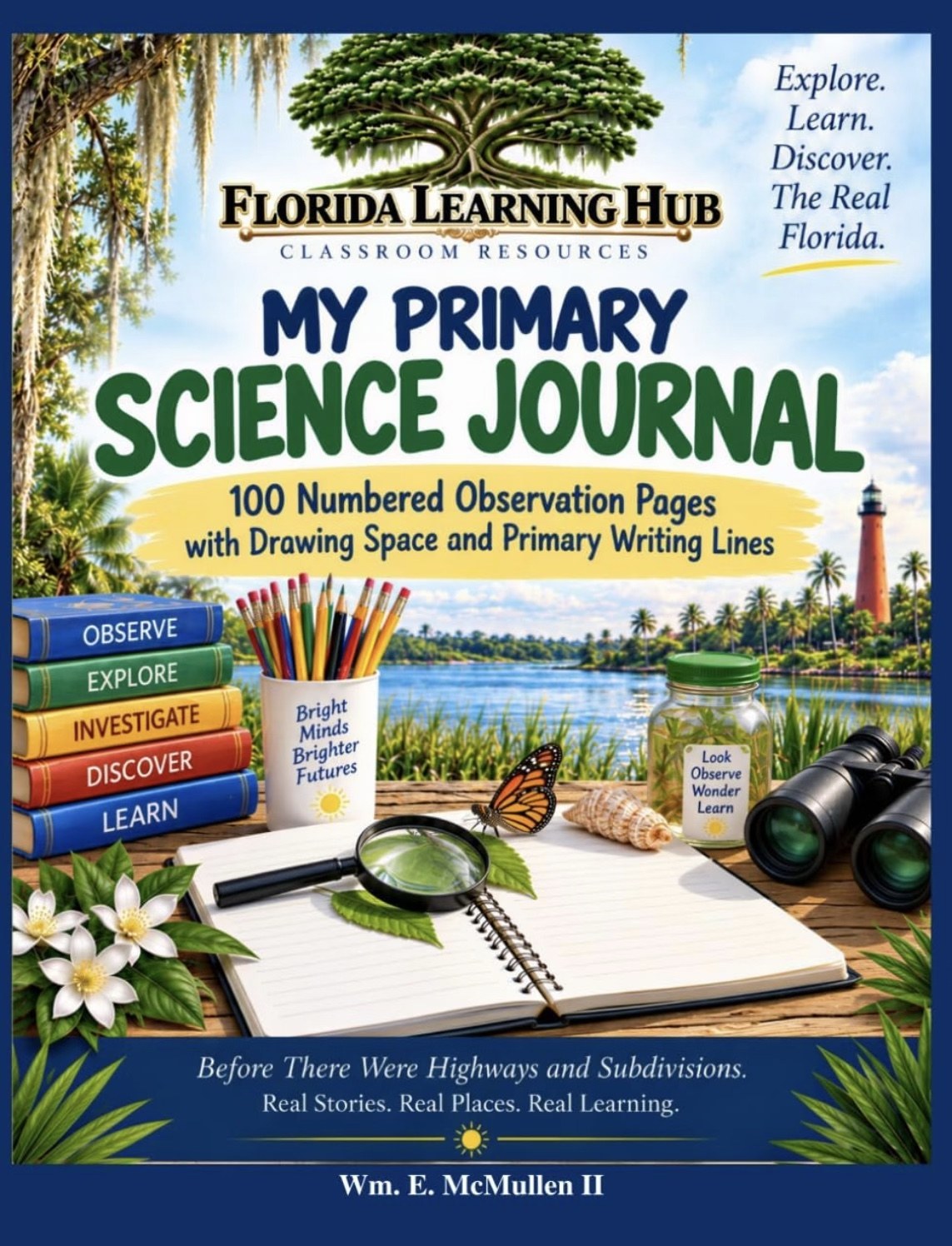
Cover of My Primary Science Journal

My Primary Science Journal

Book Description

Give young scientists a place to observe, draw, wonder, and discover.

My Primary Science Journal provides 100 numbered observation pages designed for young learners beginning to explore the world through science. Each observation page includes a large space for drawings, diagrams, and labels along with primary handwriting lines for recording discoveries, questions, and ideas.

The simple “I notice…” and “I wonder…” approach encourages children to look carefully, ask questions, and put their observations into words.

Perfect for classroom science, homeschool learning, nature studies, experiments, field trips, gardens, weather observations, plants, animals, and everyday discoveries.

Features include:

  • 100 numbered science observation pages
  • Large drawing and diagram space
  • Primary handwriting lines
  • “I notice…” and “I wonder…” prompts
  • Name and date fields on every observation
  • Large 8.5 × 11 inch format
  • Ideal for classrooms, homeschoolers, and learning at home
  • Useful for experiments, nature walks, field trips, and outdoor investigations

Help turn everyday curiosity into scientific discovery—one observation at a time.

Part of the Florida Learning Hub Classroom Resources series.

Explore. Learn. Discover. The Real Florida.
Published on Amazon

See the Book on Amazon
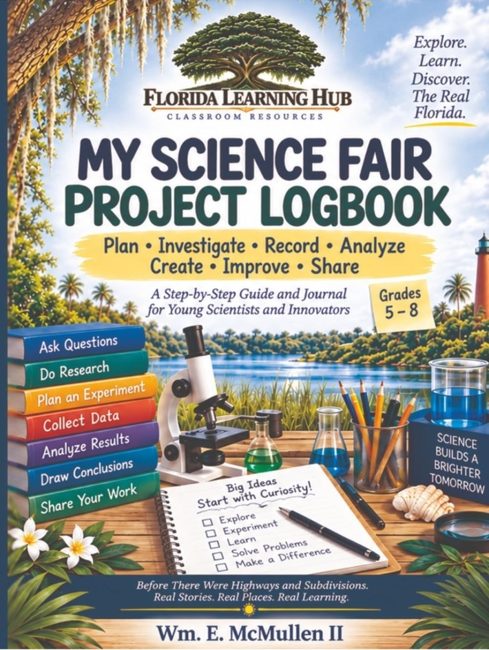
Cover of My Science Fair Project Logbook

My Science Fair Project Logbook

Hardcover Available Now

Paperback Published on Amazon

Book Description

Turn a science fair project into an organized journey from the first big question to the final presentation.

My Science Fair Project Logbook is a comprehensive project guide and working journal designed for students in Grades 5–8. It gives young scientists and engineers one place to plan their project, conduct background research, document experiments and designs, record raw data, analyze results, and prepare for presentation and judging.

Students can follow either a Scientific Investigation pathway or an Engineering Design pathway, making the logbook useful for traditional experiments, engineering challenges, inventions, and problem-solving projects.

Inside students will find:

  • Project idea and topic-selection pages
  • Background research and source-record pages
  • Research question and hypothesis development
  • Variables, controls, and experimental-design planning
  • Engineering problems, criteria, constraints, and design planning
  • Rules, approval, risk, and safety checklists
  • Materials and detailed procedure pages
  • Trial, sample-size, and measurement planning
  • 40 dated research-log pages
  • 20 raw-data table pages
  • 10 graph-paper pages
  • Calculation and data-analysis worksheets
  • Results, error, uncertainty, and limitations analysis
  • Conclusion and engineering-evaluation pages
  • Engineering redesign and iteration pages
  • Abstract and display-board planning
  • Presentation and science-fair judging practice
  • Final project checklist

The structured format encourages students to ask questions, document what actually happened, learn from unsuccessful trials, use evidence, and communicate their findings clearly.

Ideal for classroom science fairs, homeschool science projects, STEM programs, independent investigations, and young innovators in Grades 5–8.

Part of the Florida Learning Hub Classroom Resources series.

Explore. Learn. Discover. The Real Florida.
See Hardcover on AmazonSee Paperback on Amazon
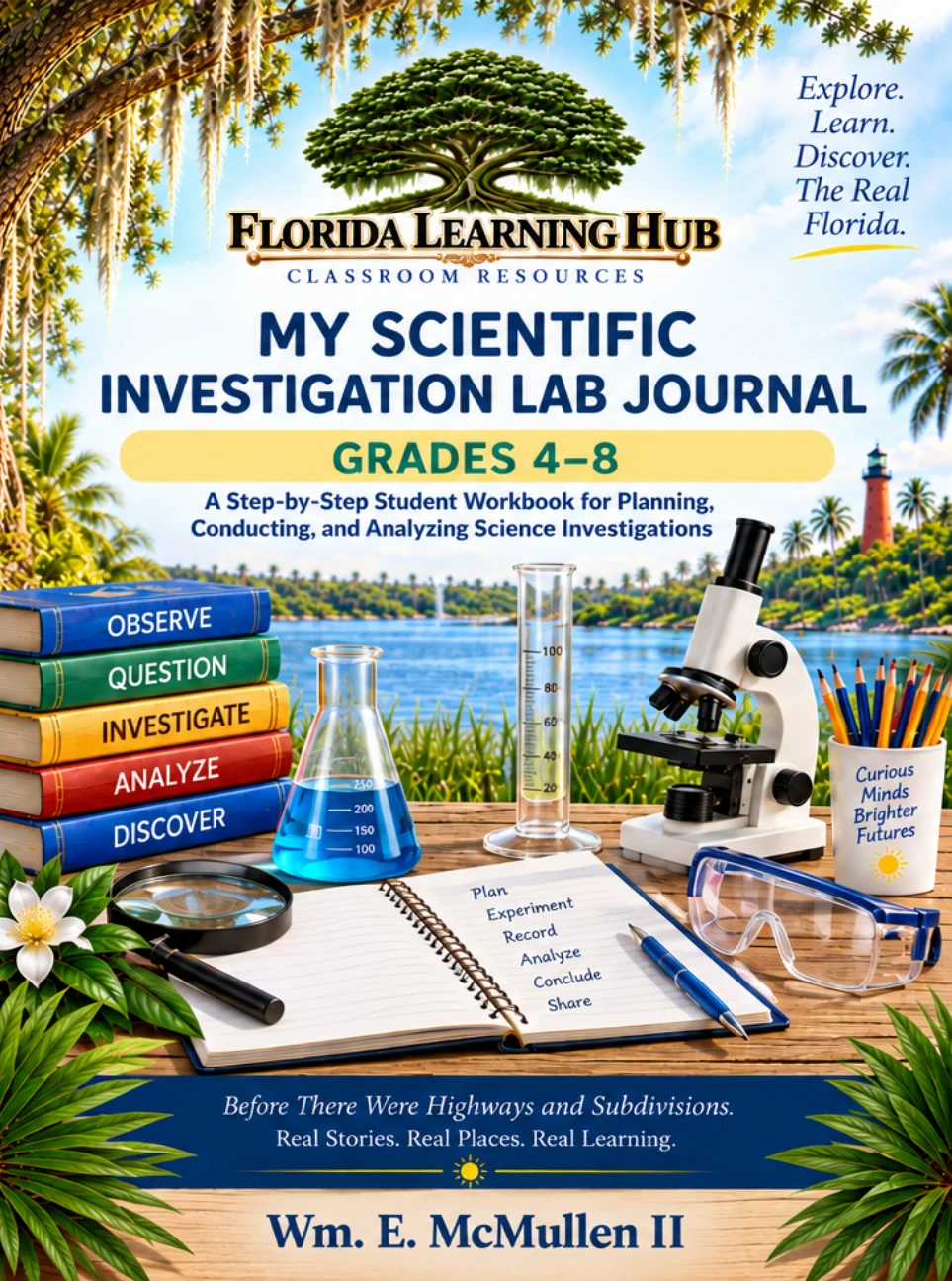
Cover of My Scientific Investigation Lab Journal — Grades 4–8

My Scientific Investigation Lab Journal — Grades 4–8

A guided workbook for planning, conducting, recording, analyzing, improving, and communicating science investigations.

Published on Amazon

See the Book on Amazon
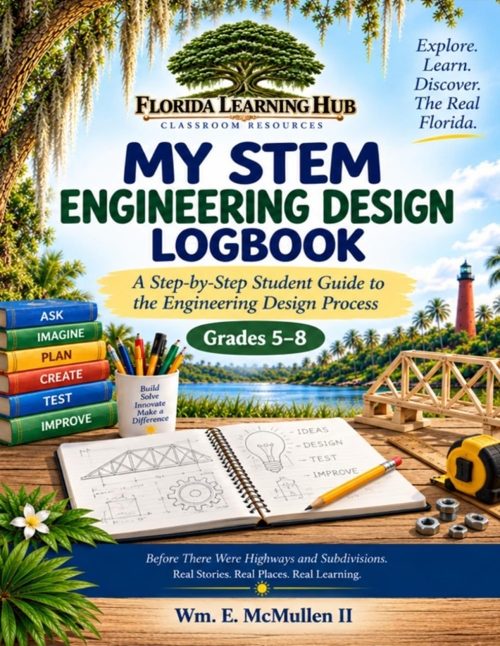
Cover of My STEM Engineering Design Logbook

My STEM Engineering Design Logbook

Book Description

Turn an idea into a solution through the engineering design process.

My STEM Engineering Design Logbook is a guided student workbook for Grades 5–8 that takes young engineers from identifying a problem through designing, building, testing, improving, and presenting a solution.

Students learn to ASK, RESEARCH, IMAGINE, PLAN, CREATE, TEST, ANALYZE, IMPROVE, RETEST, and COMMUNICATE while documenting the evidence and decisions behind their designs.

Inside, students work with problem statements, users and stakeholders, measurable criteria, constraints, safety and risk, environmental impacts, research, brainstorming, concept sketches, decision matrices, trade-offs, technical drawings, materials and costs, prototype construction, fair testing, quantitative data, graphs, failure analysis, redesign, optimization, engineering ethics, and presentation skills.

Dedicated build logs, test sessions, redesign pages, engineering notebook pages, and reusable STEM challenges provide plenty of room for authentic project work.

Students are also introduced to responsible use of digital tools and AI in engineering, with an emphasis on verification, safety, original decision-making, and following teacher and school requirements.

Ideal for STEM classrooms, science and engineering projects, makerspaces, homeschool programs, project-based learning, engineering clubs, and independent student projects.

Part of the Florida Learning Hub Classroom Resources series.

Explore. Learn. Discover. The Real Florida.
See the Book on Amazon
Nature & Field Science

Take Learning Outdoors

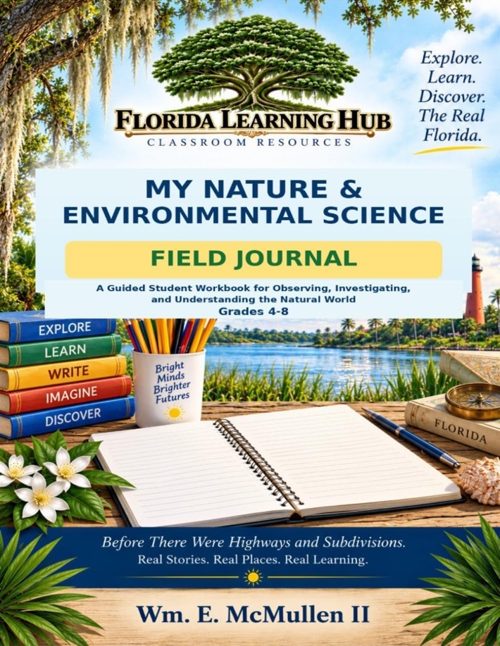
Cover of My Nature and Environmental Science Field Journal

My Nature & Environmental Science Field Journal

Book Description

Take science beyond the classroom and into the natural world.

My Nature & Environmental Science Field Journal is a guided student workbook for Grades 4–8 that teaches young scientists how to observe, investigate, measure, record, compare, and explain what they discover outdoors.

Students develop real field-science skills while exploring habitats, weather, water, soil, plants, wildlife, biodiversity, ecosystems, environmental change, and human impacts. They learn to distinguish observations from inferences, collect qualitative and quantitative data, make scientific sketches, design field investigations, organize measurements, graph results, evaluate evidence, and draw responsible conclusions.

Inside are dedicated field-observation logs, organism records, data tables, graphing pages, Florida ecosystem studies, and ready-to-use environmental investigations. Students also learn responsible wildlife observation, field safety, environmental stewardship, data integrity, and appropriate use of digital tools and AI.

Designed for flexible use in classrooms, homeschool programs, environmental education, nature centers, field trips, science clubs, parks, schoolyards, and independent outdoor investigations.

Grades 4–8

Part of the Florida Learning Hub Classroom Resources series.

Explore. Learn. Discover. The Real Florida.
See the Book on Amazon
A Growing Collection

More Classroom Resources Are Coming

Future Florida Learning Hub resources will expand into primary-source investigation, Florida history field learning, vocabulary, field trips, independent projects, and additional science and environmental studies.

Real Stories. Real Places. Real Learning.