Florida Faces the Cuban Missile Crisis
1962 — Kennedy’s October 22 address brought a nuclear confrontation in nearby Cuba into American homes.
By Wm. E. McMullen II
A President’s Evening Warning
On October 22, 1962, President John F. Kennedy appeared on television and radio to announce that the Soviet Union was building offensive missile installations in Cuba. He described weapons capable of delivering nuclear warheads to cities across much of the Western Hemisphere. Among the places he named was Cape Canaveral, Florida’s increasingly important center for missile and space launches. For people listening in Florida, the confrontation was both an international emergency and a threat connected to familiar geography. Cuba lay just beyond the peninsula’s southern waters. [1]
Kennedy announced a naval quarantine intended to stop additional offensive military equipment from reaching Cuba. He also demanded the removal of the missiles already there. The broadcast made a developing confrontation public; it did not mark the discovery of the installations. Reconnaissance, analysis, and deliberations had preceded the speech. The distinction matters because citizens heard a policy decision after officials had already spent days considering evidence and possible responses.
Why Missiles in Cuba Changed the Calculation
The crisis grew from the Cold War rivalry between the United States and the Soviet Union. Both governments possessed nuclear weapons, making any direct conflict potentially catastrophic. A missile installation could affect decisions long before a weapon was fired. Its location influenced warning time, military planning, and the pressure on political leaders to act before their opponents did.
Cuba’s position made that problem especially immediate for Florida. The state projected into the Caribbean region, facing an island that had become closely aligned with the Soviet Union. Military planners could not treat the peninsula as a distant rear area when a new threat approached from the south. Florida’s coastline became part of the nation’s defensive perimeter in a much more visible way. The same map that made the state a gateway for trade and travel also made it a place of strategic exposure.
The word “quarantine” described a controlled restriction on shipping, rather than a general announcement that every vessel would be attacked. Kennedy’s speech combined a military measure with diplomatic demands. That combination reveals the central difficulty: the administration wanted the missiles removed while trying to prevent a confrontation from becoming nuclear war. An order at sea could therefore carry consequences far beyond the ship receiving it.
Florida’s Landscape Becomes a Military Position
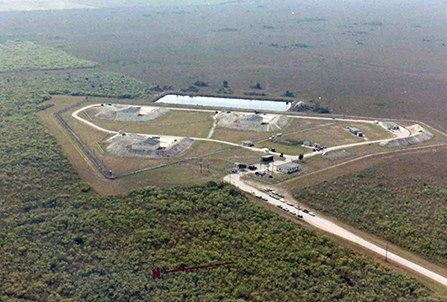
The National Park Service’s history of the HM-69 missile base explains how rapidly South Florida’s defenses changed. In late October, the Army’s 2nd Missile Battalion, 52nd Air Defense Artillery deployed south. Two batteries established tent encampments near the entrance to Everglades National Park. The soldiers encountered heat, humidity, frequent rain, and mud while maintaining equipment that had to remain ready for use. [2]
This was the practical work behind the language of national security. An air-defense position required trained crews, communications, maintenance, and a workable place to operate. Moving a missile into the region was only one part of creating a defensive system. Men had to live beside their equipment and keep it functioning in a landscape very different from a controlled workshop or permanent barracks.
South Florida’s Nike Hercules and Hawk missile sites provided complementary air-defense capabilities. Their assignment must be distinguished from the Soviet ballistic missiles Kennedy described in Cuba. The American batteries discussed here were intended to defend against aircraft. Treating every missile as the same kind of weapon obscures both the danger Kennedy announced and the purpose of the local installations.
A Crisis Leaves a Permanent Footprint
The preserved HM-69 installation did not spring into existence during the October 22 broadcast. The Army Corps of Engineers completed the permanent base in 1964, and A Battery moved there in 1965. Its military use continued until 1979. Those dates show how a short period of extreme alarm could produce a much longer commitment of land, buildings, personnel, and public resources. [2]
A later photograph of the missile barns therefore illustrates the crisis’s aftermath. It cannot show precisely how the temporary camps looked on the evening Kennedy spoke. Keeping those stages separate makes the story more interesting: an emergency response became an enduring installation, and that installation eventually became a historic resource. The site’s changing purpose is itself part of Florida history.
The contrast with its surroundings is striking. Everglades National Park protects a landscape associated with water, wildlife, and ecological processes. Within that setting, the missile base records another national priority. Preserving it helps explain that protected landscapes can contain evidence of conflict as well as nature. A visitor encountering the buildings can ask why military officials chose the location and how national decisions altered the use of public land.
Decisions Measured Against Consequences
Kennedy’s address is also a lesson in how leaders communicate uncertainty and resolve. He presented reconnaissance findings, described a threat, and announced actions before the ultimate outcome was known. Reading the speech as a contemporary document restores that uncertainty. The people hearing it could not simply turn to the next page of a history book to discover what would happen.
For a Florida family, a service member, or a park employee, the national announcement could have different practical meanings. Their individual reactions should be reconstructed from letters, interviews, and local records rather than invented. What can be established from the official record is the connection between the warning from Washington and the defense preparations in South Florida. The crisis brought decisions made at the highest level into specific places where people worked and lived.
Why It Matters to Florida
The proximity was not just a matter of miles. Florida already contained facilities important to national defense and the space program. A threat to those facilities could affect operations serving the whole country. The peninsula’s significance therefore combined location with investment: the things built there made its position matter even more. This helps explain why the president’s reference to Cape Canaveral carried a particular weight for listeners following America’s space ambitions.
October 22 connects Florida’s geography to the history of nuclear diplomacy, military readiness, and public communication. Cape Canaveral appeared in the president’s warning, while the Everglades became part of the defense response. The peninsula was simultaneously a possible target, a military operating area, and a place where civilians listened for news about their future.
The anniversary also explains why an apparently quiet historic site deserves attention. HM-69 preserves the physical consequences of a confrontation that might otherwise seem to exist only in speeches and world maps. Its buildings make the Cold War local. Florida’s history of national defense did not end with coastal forts and wartime airfields; it continued into an era when decisions about a nearby island could raise the possibility of destruction across an entire hemisphere.
Classroom Connection
Reading Prompt
Before reading: Why might Florida’s location make an international crisis feel especially close to home?
Glossary
- Quarantine
- A restriction on shipping intended to prevent specified cargo from reaching a destination.
- Reconnaissance
- Gathering information by observing an area or activity.
- Air defense
- Measures intended to protect an area against attack from the air.
- Diplomacy
- Negotiation and communication between governments.
Reading Check
- What did Kennedy announce on October 22, 1962?
- How did the temporary South Florida camps differ from the later HM-69 base?
Think and Discuss
How can the same geographic location create opportunities for trade and risks for national defense?
Short Writing Prompt
Write a paragraph explaining how the Cuban Missile Crisis changed the use of a Florida landscape. Use two details from the article and distinguish 1962 events from later construction.
Teacher Notes and Suggested Answers
Kennedy announced the discovery of Soviet offensive missile installations and a naval quarantine. Temporary camps supported the immediate response; the permanent HM-69 base was completed in 1964 and occupied by A Battery in 1965. Look for a clear connection between geography and military decisions in student responses.
Suggested use: introduce the reading prompt, read the account, check comprehension, then select the discussion or writing task. Adapt vocabulary and response length to the class.
Sources and Further Reading
- John F. Kennedy Presidential Library and Museum. Radio and Television Report to the American People on the Soviet Arms Buildup in Cuba, October 22, 1962.
- National Park Service, Everglades National Park. HM69 Nike Missile Base.
Explore the daily archive: Discover more events that shaped Florida.
Today in Florida History