Deep Space 1 Leaves Cape Canaveral
1998 — A Florida launch sent a technology-testing spacecraft toward a new way of navigating and traveling through space.
By Wm. E. McMullen II
An Experiment Leaves Florida
On October 24, 1998, a Delta II rocket carried NASA’s Deep Space 1 away from Launch Complex 17A at Cape Canaveral. The spacecraft had a demanding assignment: demonstrate technologies that future explorers might need before those explorers depended on them. Its departure linked Florida’s launch coast to a practical question at the heart of space exploration. How could spacecraft travel farther, navigate more independently, and accomplish more with limited mass and power? [1]
Deep Space 1 was managed by NASA’s Jet Propulsion Laboratory and belonged to the agency’s New Millennium program. Its central purpose was engineering. Although encounters with an asteroid and a comet became important parts of its story, the spacecraft first had to show that a dozen technologies could work beyond Earth. The flight was an investment in later missions as well as an exploration in its own right.
Why a Test Mission Was Necessary
A promising device on Earth is not automatically ready for a spacecraft. Laboratory equipment can receive constant attention. Technicians can replace parts, change connections, and repeat a test after a failure. A deep-space vehicle must operate where repairs are usually impossible. Sunlight, temperature, communications delays, and limited electrical power create conditions that cannot be reproduced perfectly in a workshop.
A demonstration mission accepts the task of encountering those conditions first. It can reveal weaknesses without making another spacecraft’s principal scientific objective depend entirely on untried hardware. That does not eliminate risk. It places risk where learning from it is a central purpose of the flight.
Deep Space 1’s technologies included ion propulsion, autonomous navigation, solar-power equipment, and compact instruments. Their relationship mattered as much as their individual performance. A propulsion system needed electricity; navigation needed observations; communications had to connect the spacecraft with people on Earth. The machine was a working system, not a collection of inventions that could be judged entirely in isolation.
A Gentle Engine With a Long Assignment
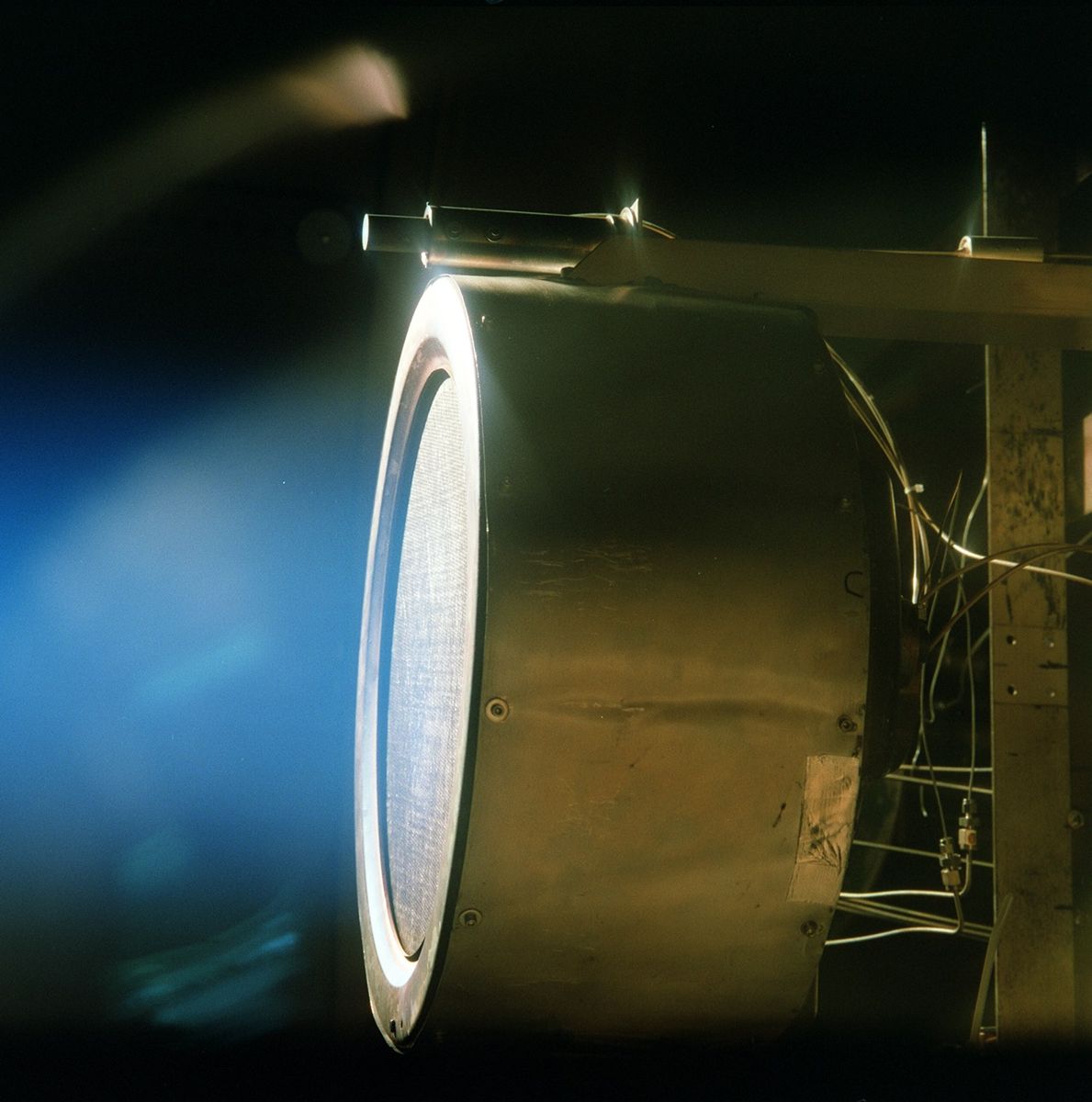
The ion engine used electricity to accelerate charged xenon particles. Expelling those particles produced thrust in the opposite direction. The push was small, but it could continue for long periods. A gentle acceleration sustained over time could produce a useful change in the spacecraft’s velocity. [3]
That principle differs from the immediate force required to lift a launch vehicle from Florida. Deep Space 1 did not rise from the pad on its ion engine. The Delta II and its stages accomplished the launch and departure. The experimental propulsion system performed its work after the spacecraft was already in space.
The distinction helps explain why different engines suit different jobs. An efficient engine is valuable only if it can provide the performance required for the particular task. A system designed for a long cruise need not resemble one designed to overcome gravity and atmospheric resistance during launch. Deep Space 1 demonstrated the value of matching propulsion to the journey rather than judging every engine by the spectacle of liftoff.
Years of Work Behind the Departure
NASA Glenn’s history traces the engine’s roots to research begun decades earlier. Long laboratory endurance tests preceded the flight, and NASA centers worked with industry to turn experimental hardware into a flight system. Those earlier efforts are easy to miss when an anniversary focuses on the rocket leaving the pad. [3]
Florida supplied the departure point, but the mission embodied work distributed across laboratories, manufacturing facilities, control rooms, and launch operations. A spacecraft’s history includes the people who design and test it as well as the people visible beside the rocket. Recognizing that network makes the Space Coast’s role clearer: it connected a national engineering effort to an actual journey beyond Earth.
Navigation Without Constant Directions
Deep Space 1 also tested autonomous optical navigation. In plain language, it used observations to help determine its own course. For a distant spacecraft, this capability offered a way to perform some navigation work aboard the vehicle instead of requiring every decision to arrive from ground controllers. [1]
Autonomy did not mean independence from all human planning. Engineers designed the software, established the mission’s objectives, and monitored the spacecraft. The experiment shifted particular tasks to the machine while leaving the overall enterprise a human undertaking. That balance is a useful way to understand automation: a system may perform a calculation or recognize a pattern without choosing the larger purpose it serves.
Encounters, Failures, and Recovery
The spacecraft passed asteroid Braille in July 1999. The encounter produced useful information, but imaging and navigation difficulties limited the results. NASA’s account therefore distinguishes a successful technology mission from an imperfect scientific encounter. A mission can teach valuable lessons without every planned observation succeeding. [1]
Later, the failure of the star tracker threatened the extended mission. The operations team developed a way to control the spacecraft without that instrument. This recovery illustrates another part of exploration that a launch photograph cannot show: engineers responding to an unexpected limitation with new procedures and software.
In September 2001, Deep Space 1 encountered comet Borrelly and returned images and scientific data. The journey had grown beyond the initial tests while continuing to demonstrate the durability and usefulness of the technologies aboard it. Its ion propulsion system accumulated more than sixteen thousand operating hours before the mission ended in December 2001. The same broad propulsion approach later served NASA’s Dawn mission. [3]
Why It Matters to Florida
The mission also illustrates why engineering progress often depends on measurement rather than appearance. An ion engine’s small thrust might look unimpressive beside a launch rocket, yet its accumulated performance could change a mission’s possibilities. Evaluating it required asking how long it operated and what change it produced. That attention to the task, rather than the spectacle, helps readers understand why a relatively small robotic spacecraft could have an influence extending well beyond its own journey.
October 24 belongs to Florida’s space history because the demonstration began with a launch from Cape Canaveral. Its importance reaches beyond the countdown. Deep Space 1 helped turn technologies that carried substantial uncertainty into tools later mission planners could consider with greater confidence.
The anniversary expands the familiar story of Florida launches. Some missions carried people; others placed satellites in Earth orbit or traveled to scientific targets. This one also carried a question about how the next generation of journeys could be accomplished. Its value lay partly in information that would shape spacecraft not yet launched.
Remembering Deep Space 1 therefore means following the story after the rocket disappears from view. The patient operation of an engine, the interpretation of observations, and the recovery from equipment failure were as consequential as the departure. Florida’s launch coast served as the opening chapter in an experiment whose results helped make later exploration possible.
Classroom Connection
Reading Prompt
Before reading: Why might NASA launch a mission mainly to test equipment for other missions?
Glossary
- Ion
- An atom or molecule carrying an electrical charge.
- Thrust
- The force produced by an engine to change motion.
- Autonomous navigation
- A spacecraft’s use of onboard observations and software to help determine its course.
- Technology demonstration
- A test of whether a new system can perform under actual operating conditions.
Reading Check
- Where and when did Deep Space 1 launch?
- Why was the ion engine useful in space but unsuitable for launching the spacecraft from the pad?
Think and Discuss
Can an experiment be valuable when one part of its performance falls short of expectations?
Short Writing Prompt
Explain why Deep Space 1 mattered beyond its own journey. Use evidence about propulsion and one other technology or engineering challenge.
Teacher Notes and Suggested Answers
It launched from Cape Canaveral’s Launch Complex 17A on October 24, 1998. Ion propulsion provided small sustained thrust; the Delta II supplied launch performance. Strong responses distinguish testing, learning, and later use rather than treating every part of the mission as equally successful.
Suggested use: introduce the reading prompt, read the account, check comprehension, then select the discussion or writing task. Adapt vocabulary and response length to the class.
Sources and Further Reading
- NASA Science. Deep Space 1: mission facts, technologies, launch site, and mission timeline.
- NASA Jet Propulsion Laboratory. Deep Space 1 mission overview.
- Robert S. Arrighi, NASA Glenn Research Center. NASA History: Deep Space 1 Validated the Promise of Ion Thrusters, December 18, 2019.
Explore the daily archive: Discover more events that shaped Florida.
Today in Florida History