A National Park Protects the Dry Tortugas
1992 — Congress redesignated an already protected island fortress and its surrounding waters as Dry Tortugas National Park.
By Wm. E. McMullen II
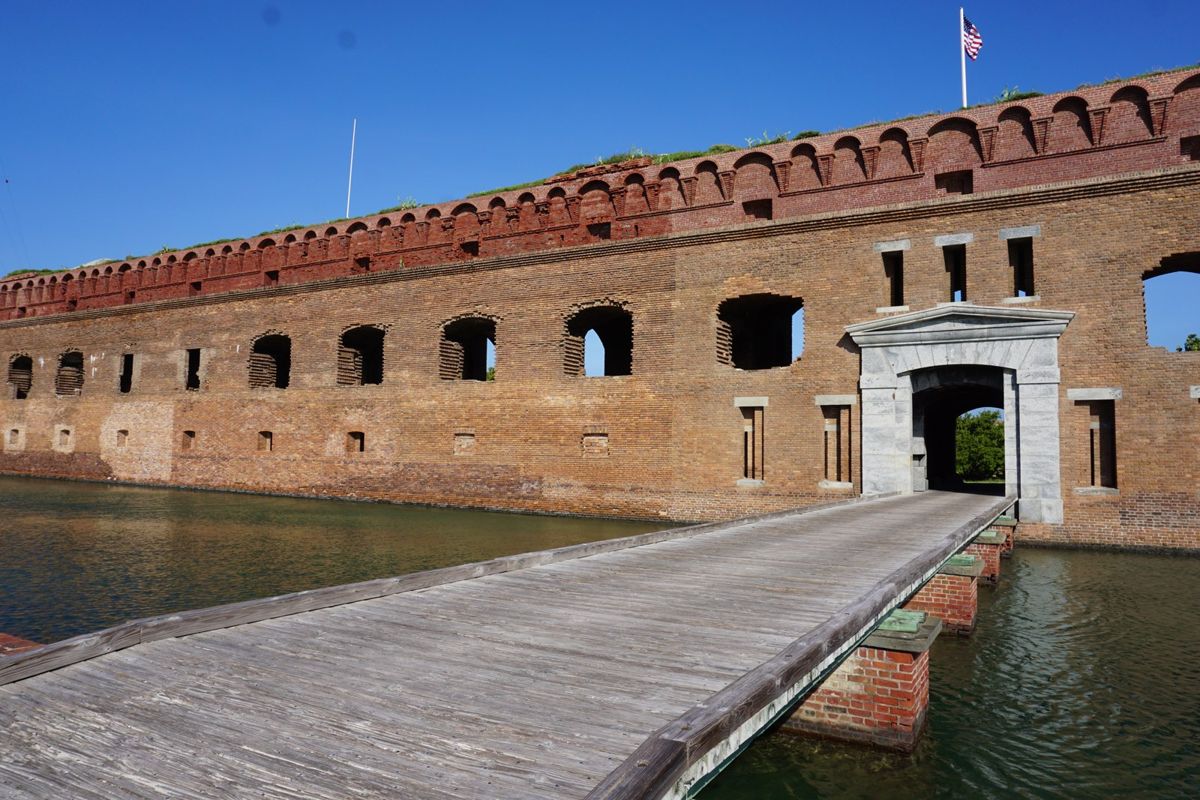
A New Name for a Connected Place
On October 26, 1992, Congress redesignated Fort Jefferson National Monument as Dry Tortugas National Park. The change recognized a place whose importance reached beyond the walls of its enormous masonry fort. Islands, surrounding waters, coral communities, wildlife, shipwrecks, and military remains belonged to one protected setting. The anniversary marks a decision about stewardship: which parts of that setting should be protected, and how should they be understood together? [1]
The islands had already received federal protection. President Franklin D. Roosevelt established Fort Jefferson National Monument on January 4, 1935, and its boundaries later changed. The 1992 legislation did not announce a discovery or create the fort. It established a national park with explicit purposes broad enough to include natural and cultural resources on both sides of the shoreline.
Geography Explains the History
The Dry Tortugas lie about seventy miles west of Key West. Their position near shipping routes between the Atlantic, the Caribbean, and the Gulf helps explain why this remote group of islands attracted so much attention. A place that seems isolated to someone approaching from the mainland can be strategically important to people moving by sea. Distance from a city is not the same as distance from a valuable route.
The surrounding reefs made navigation hazardous. The National Park Service describes the area as a place of numerous shipwrecks and explains the importance of its lighthouses. A light at Garden Key and the later lighthouse on Loggerhead Key helped mariners identify danger. Their presence reflects the same basic reality that drew military interest: vessels passed through waters where location mattered greatly. [1]
A chart of the islands therefore opens several histories at once. It shows possible approaches, obstacles, and places of shelter. Those features affected commerce and defense while also shaping the conditions in which marine life flourished. The 1992 park designation made that relationship central to the protected area’s identity.
Why Build Fort Jefferson Here?
Construction of Fort Jefferson began in 1846. The United States wanted a substantial defensive position near an important maritime gateway. The great brick structure on Garden Key embodied a nineteenth-century approach to controlling strategic waters through permanent fortification. A fixed installation could provide a place from which military power might be sustained near a shipping route. [1]
Building on a remote island imposed practical burdens. Materials, equipment, and supplies had to reach the site by water. The fort also faced settlement problems and concerns about the pressure additional construction would place on its structure and water-storage system. It was never completed. The unfinished condition is part of its history, rather than a reason to imagine it as a fully realized plan.
These difficulties connect military ambition to engineering and environment. Choosing a strategically attractive place did not remove the constraints of soil, water, transport, and maintenance. The fortress records both what the nation wanted to accomplish and what working in that location demanded. Its massive appearance can conceal how dependent it was on supplies and careful management.
Protecting More Than a Building
The enabling legislation identifies natural, historic, scenic, marine, and scientific values. Its management purposes include protecting reef communities, fish and wildlife, the islands’ natural environment, Fort Jefferson, and submerged cultural resources. It also allows scientific research consistent with those protective purposes. The law gives the park an interconnected assignment. [2]
That assignment helps explain the broader name. A monument associated chiefly with a fortress can lead a visitor to concentrate on the building. A national park encompassing the Dry Tortugas asks the visitor to consider the setting as a whole. The fort remains essential, but so do resources that cannot be seen from a photograph of its entrance.
Shipwrecks illustrate this connection particularly well. They are cultural resources underwater, products of human travel preserved within a marine environment. Studying them requires attention to both historical evidence and physical conditions. Their location can help explain navigation, trade, technology, and the risks of moving through these waters.
Wildlife and History Share the Shoreline
The law specifically names sea turtles and bird populations among the resources to protect. This is more than a list of attractions. It establishes that the islands have importance beyond their use by people. Wildlife needs and cultural preservation must both be considered when managing access and activities. [2]
The boundary between these responsibilities is not always a neat line on a map. A visitor arriving to see the fort passes through the environment the park is also responsible for protecting. Decisions about transport, waste, movement, and maintenance can affect both the historic structure and its surroundings. A connected park requires connected management.
That idea offers a useful way to read other Florida landscapes. A place may contain a historic building, archaeological evidence, wetlands, and wildlife habitat at the same time. Selecting one subject for a sign or a photograph does not erase the others. The Dry Tortugas make the overlap especially visible because so much of the protected setting is water.
Preservation Is Continuing Work
The National Park Service describes ongoing stabilization and restoration needs at Fort Jefferson. Time, weather, and water continue acting on the masonry. A legal designation can establish responsibility and protection, but it cannot stop deterioration by itself. Preservation requires inspection, maintenance, knowledge, and resources. [1]
The same principle applies to submerged remains and natural systems. Establishing a park begins an obligation that must be carried forward. The people who visit it inherit the benefits of earlier decisions, while present managers make choices that affect what future visitors will encounter. An anniversary of legislation is therefore also an anniversary of a continuing public commitment.
Why It Matters to Florida
The legislation also made public access a responsibility to manage rather than an unlimited entitlement to use every resource in any way. A park must make its significance understandable while preserving what gives the place value. That balance is especially clear on small islands surrounded by sensitive waters. Visitors encounter a shared inheritance, and the conditions of their visit can affect what remains available to the people who follow them.
October 26, 1992, connects Florida’s maritime and military past with conservation. The national park protects a place where shipping routes, dangerous reefs, an unfinished fortress, wildlife, and underwater evidence occupy the same landscape. Each subject helps explain the others rather than competing for the entire story.
The redesignation also shows how public understanding can expand. Protection that began under the name of a fort developed into an explicit commitment to a larger island and marine setting. Florida history includes such decisions as well as battles and voyages. Choosing what to preserve determines which evidence, places, and living systems future generations will have the opportunity to study and enjoy.
Classroom Connection
Reading Prompt
Before reading: Why might a national park protect shipwrecks and wildlife together?
Glossary
- Redesignation
- A formal change in a protected place’s legal classification.
- Ecosystem
- Living things and their physical environment interacting as a system.
- Submerged cultural resource
- Evidence of human activity preserved underwater.
- Stewardship
- Responsible care of something held for others and for the future.
Reading Check
- What changed on October 26, 1992?
- Identify one natural and one cultural resource the park protects.
Think and Discuss
How can a place’s isolation create both strategic value and practical difficulties?
Short Writing Prompt
Explain why the Dry Tortugas are more than the site of a large fort. Use evidence about geography, history, and the park’s protective purposes.
Teacher Notes and Suggested Answers
Congress redesignated Fort Jefferson National Monument as Dry Tortugas National Park. Natural examples include reefs, turtles, or birds; cultural examples include the fort and shipwrecks. Look for connections among resources, rather than a claim that federal protection began only in 1992.
Suggested use: introduce the reading prompt, read the account, check comprehension, then select the discussion or writing task. Adapt vocabulary and response length to the class.
Sources and Further Reading
- National Park Service, Dry Tortugas National Park. History & Culture: designation, geography, navigation, and Fort Jefferson.
- National Park Service. Dry Tortugas National Park Enabling Legislation, 16 U.S.C. 410xx and following sections.
Explore the daily archive: Discover more events that shaped Florida.
Today in Florida History