John Glenn Returns to Orbit from Florida at 77
1998 — Discovery’s STS-95 launch joined a famous return to space with an international crew’s scientific work.
By Wm. E. McMullen II
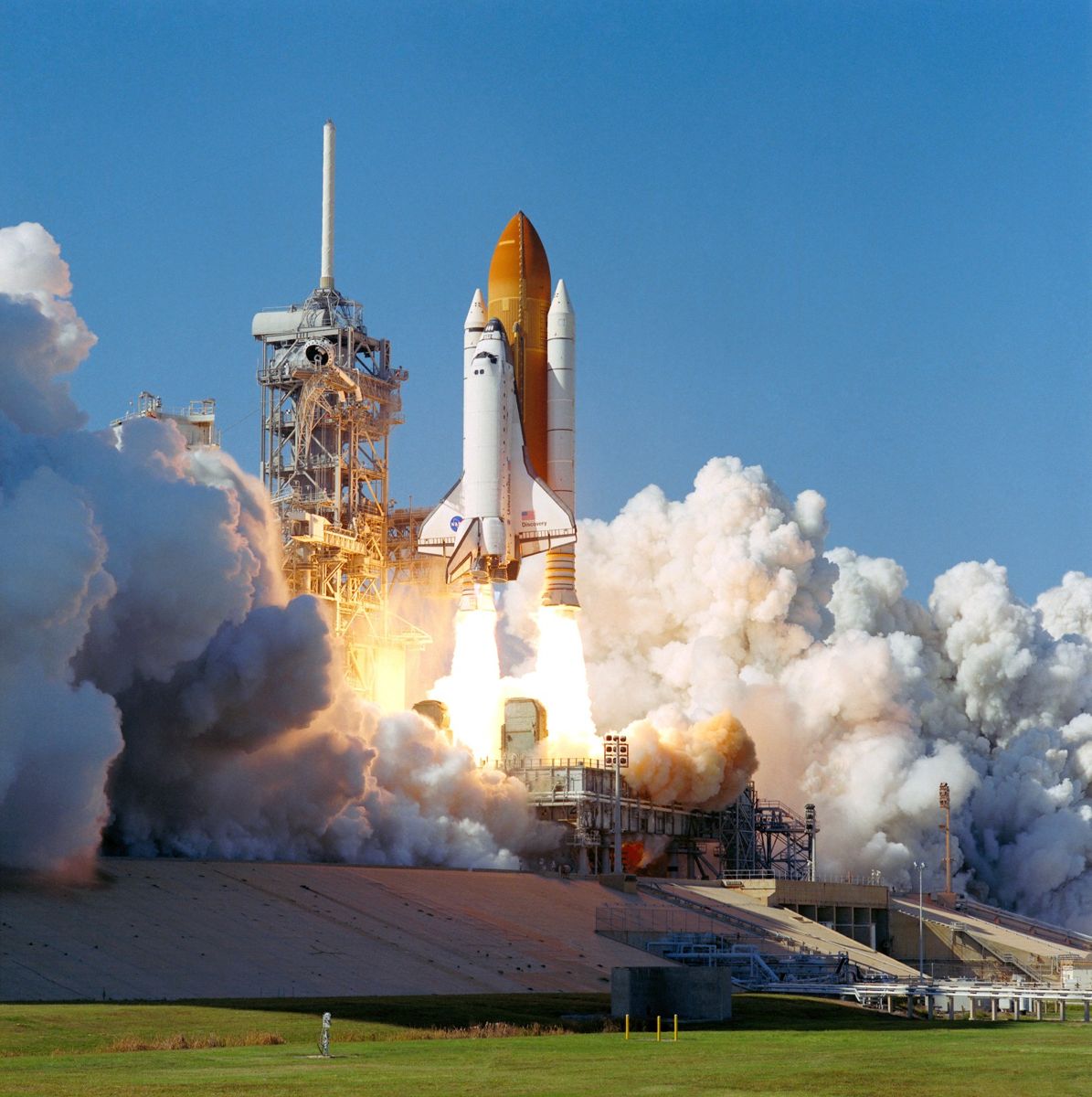
A Familiar Astronaut Leaves Florida Again
On October 29, 1998, space shuttle Discovery lifted off from Kennedy Space Center’s Launch Pad 39B with John Glenn aboard. Thirty-six years earlier, Glenn had become the first American to orbit Earth in Friendship 7. Now, at seventy-seven, he returned as a payload specialist on STS-95. His age and history drew extraordinary attention, but the flight also carried an international crew and a substantial scientific assignment. [1]
Florida connected both departures. The state’s launch coast had supported Glenn’s Mercury flight in 1962 and now supported a shuttle mission with very different equipment and capabilities. His return offered an unusually clear way to compare two eras of human spaceflight through one person’s experience.
Why Glenn Wanted to Return
Glenn had long wanted another opportunity to fly in space. NASA’s historical account explains that he became interested in similarities between certain changes associated with aging and effects experienced during spaceflight. Bone and muscle loss, sleep changes, and problems involving balance were among the questions researchers could investigate. His proposed participation therefore involved serving as a research subject as well as a crew member. [1]
The comparison required care. Weightlessness and aging are not identical conditions, and one older astronaut could not represent every older person. The scientific value lay in asking specific questions and collecting evidence, rather than assuming that a famous participant would settle an entire field of research.
Glenn also had to meet the requirements for flight. NASA’s account describes physical examinations and a research program developed with scientific review. His earlier accomplishments could explain the public interest, but they could not substitute for preparation. The return depended on fitting a personal ambition into an actual mission with tasks to perform.
Seven Crew Members Shared the Work
Curtis Brown commanded Discovery, and Steven Lindsey served as pilot. Scott Parazynski, Stephen Robinson, and Pedro Duque were mission specialists. Chiaki Mukai and Glenn served as payload specialists. Duque represented the European Space Agency, while Mukai came from Japan’s space agency. The seven names show that STS-95 belonged to a team rather than a single celebrated astronaut. [2]
Different roles carried different responsibilities. Commanding and piloting the shuttle were distinct from operating scientific equipment or conducting a particular experiment. The mission depended on those activities fitting together. A famous crew member might introduce the story to a large audience, but the work required everyone aboard and the people supporting them from Earth.
The international participation also distinguished the flight from Glenn’s first orbital journey. By 1998, the American shuttle could serve as a place where astronauts representing several countries worked together. The change was visible not just in the size of the vehicle but in the organization of the mission itself.
More Than a Return Visit
Discovery carried more than eighty experiments during nearly nine days in space. Work included medical and biological studies as well as materials research. The pressurized Spacehab module provided additional room for scientific activity. Instead of simply observing the journey, the crew had a schedule of operations to complete. [2]
Research in orbit requires ordinary discipline under unusual conditions. Procedures must be followed, observations recorded, equipment handled, and results connected to the correct experiment. Public attention may concentrate on launch and landing, while much of a mission’s value comes from patient work between those moments.
The crew also deployed and retrieved the Spartan solar-observation spacecraft. Other payloads tested technology and investigated conditions beyond Earth. Those assignments make clear why an account centered only on Glenn’s age would be incomplete. The mission’s importance included its research objectives and hardware operations, not just the personal milestone that attracted headlines.
What Researchers Could Learn
The attraction of a space-based experiment is that it places a question in conditions difficult to reproduce for long periods on Earth. Scientists can compare observations before, during, and after flight. That comparison can reveal changes and suggest further questions. It does not mean every observed difference has one simple cause.
For the aging-related work, the task was to investigate possible connections between physiological changes, rather than declare spaceflight a model for every aspect of getting older. Careful interpretation protects the science from exaggerated claims. A successful mission can produce useful measurements while leaving important questions unresolved.
This approach also explains why astronaut stories belong in science education. Exploration involves designing questions that available equipment and participants can help answer. The crew’s experience matters, but so does the way researchers decide what evidence will count. A dramatic journey and a careful experiment can occupy the same spacecraft without becoming the same kind of achievement.
Florida’s Work Beyond the Countdown
The launch depended on Kennedy Space Center’s facilities and the broader organization supporting shuttle operations. NASA’s mission record describes countdown holds and the clearance of restricted airspace before liftoff. Those details reveal the controlled process behind an event that can look instantaneous in a photograph. [2]
A launch team has to evaluate conditions, communicate decisions, and coordinate many systems before committing to flight. The people aboard rely on work performed by people who remain on the ground. Florida’s place in the story therefore includes technical labor, operational judgment, and the infrastructure that allowed the mission to begin.
Discovery returned to Kennedy Space Center on November 7, 1998. The departure and return framed days of research whose results required further study afterward. A spacecraft can land before the work of interpreting its mission is complete.
Why It Matters to Florida
Glenn’s two journeys also offer a lesson about comparison. The same person appearing in both does not make their purposes identical. Comparing vehicle, crew, duration, equipment, and objectives reveals what changed and what continued. Both depended on Florida launches and disciplined preparation, while their scientific and operational possibilities differed substantially. That comparison gives students a concrete way to examine technological change without treating one memorable person as the entire history of the space program.
October 29 connects Florida’s Mercury and shuttle histories through Glenn’s two orbital flights. The contrast makes decades of change visible: a solo capsule journey followed by a larger spacecraft carrying an international scientific crew. The familiar astronaut helped the public recognize both continuity and transformation.
The anniversary also encourages a fuller understanding of accomplishment. Glenn’s return was memorable, but STS-95 depended on a whole crew, ground teams, equipment, and research planning. Remembering those connections makes the story more useful than a record about age alone. From Florida, the mission carried both a veteran explorer’s ambition and a collective effort to learn more about the human body, technology, and the environment beyond Earth.
Classroom Connection
Reading Prompt
Before reading: What might be gained—and lost—when a mission is remembered mainly through one famous participant?
Glossary
- Orbit
- A path followed around another body under gravity.
- Payload specialist
- A crew member assigned expertise or work associated with a mission’s payload.
- Physiology
- The study of how living bodies function.
- Microgravity
- Conditions of apparent near-weightlessness experienced during orbital free fall.
Reading Check
- Where did Discovery launch on October 29, 1998?
- Identify one research objective beyond Glenn’s personal return to space.
Think and Discuss
Why does a comparison between aging and spaceflight require careful limits?
Short Writing Prompt
Compare Glenn’s 1962 and 1998 flights using crew, purpose, and spacecraft. Explain one continuity and two changes supported by the article.
Teacher Notes and Suggested Answers
Discovery launched from Kennedy Space Center’s Pad 39B. Examples include medical research, materials experiments, solar observations, and technology tests. Strong responses identify the international crew and avoid claiming that one person’s results explain all aging or that the mission was merely ceremonial.
Suggested use: introduce the reading prompt, read the account, check comprehension, then select the discussion or writing task. Adapt vocabulary and response length to the class.
Sources and Further Reading
- John Uri, NASA Johnson Space Center. 25 Years Ago: STS-95, John Glenn Returns to Space, October 30, 2023.
- NASA. STS-95 mission record: crew, launch, landing, and research objectives.
Explore the daily archive: Discover more events that shaped Florida.
Today in Florida History