
Union Forces Take St. Johns Bluff
October 3, 1862 — A combined Army-Navy operation opens the river toward Jacksonville.
By Wm. E. McMullen II
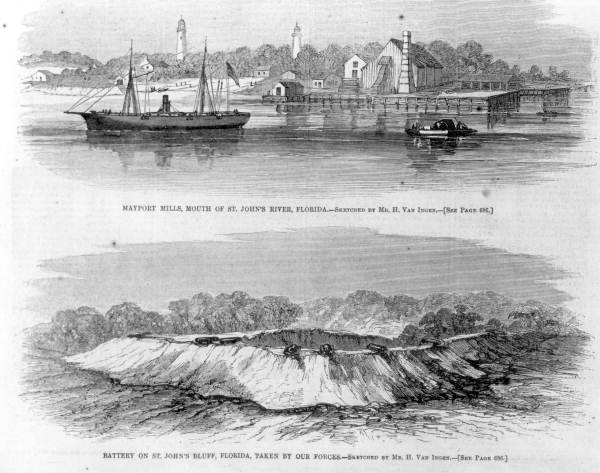
On October 3, 1862, Union sailors and soldiers occupied the Confederate position at St. Johns Bluff. The guns that had threatened federal ships were silent: the defenders had withdrawn during the night after a Union force landed behind them.
The River Was the Objective
The St. Johns River was Northeast Florida's great transportation corridor. Control of its mouth gave ships access toward Jacksonville and deeper into the interior. Confederate forces placed heavy guns on the bluff, a high point overlooking the river east of Jacksonville, to block that route.
Union gunboats had challenged the position but faced well-directed fire. A frontal naval attack alone would be costly. Federal commanders instead organized a joint expedition that combined ships, infantry, artillery and cavalry.
Landing Behind the Guns
Brigadier General John M. Brannan left Hilton Head, South Carolina, on September 30 with about 1,500 troops aboard transports. At the mouth of the St. Johns, his force joined a flotilla that included the gunboats Paul Jones, Cimarron, Uncas, Patroon, Hale and Water Witch.
On October 1, ships exchanged fire with the Confederate batteries while troops landed at Mayport Mills. Another force came ashore at Mount Pleasant Creek, about five miles behind the bluff, and advanced overland on October 2. The maneuver threatened to cut off Lieutenant Colonel Charles F. Hopkins and his garrison.
An Abandoned Position
Hopkins decided that his limited infantry and ammunition could not withstand the larger force closing from the rear. Confederate troops abandoned the batteries after dark on October 2. When Union gunboats moved toward the bluff the next day, they found the position empty and occupied it without a final battle.
Confederate Brigadier General Joseph Finegan initially called the evacuation a serious blunder. A later court of inquiry concluded that Hopkins could not have defended the batteries successfully and was justified in saving his command.
What the Victory Opened
With St. Johns Bluff neutralized, Union forces moved upriver and occupied Jacksonville on October 5. They also captured the Confederate steamer Governor Milton. The campaign strengthened the blockade and demonstrated how naval mobility and troops ashore could work together.
The operation also depended on local intelligence. National Park Service research notes that freedom seekers who reached Union lines supplied information about Confederate movements and sometimes served as guides. Their knowledge helped federal forces navigate a contested landscape.
Why It Matters
St. Johns Bluff was a victory won largely by position and pressure rather than a bloody charge. Union commanders used the river, ships and an overland landing to make the Confederate battery untenable.
The episode reveals why Florida's waterways mattered during the Civil War. Rivers carried troops, supplies, news and trade. Whoever controlled the St. Johns could project power into Northeast Florida—and the silent guns on October 3 showed that control shifting toward the Union.
Sources for Additional Reading
- National Park Service — Battle Detail: Saint John's Bluff
- Naval History and Heritage Command — USS Water Witch
- Florida Memory — Florida in the Civil War Timeline
- Florida Memory — Mayport and St. Johns Bluff Illustrations, RC05591
Explore the daily archive: Discover more events that shaped Florida's communities, culture and history.
Today in Florida History