Army Ferries
The Single Canoe That Nearly Stalled a Campaign
General Duncan Lamont Clinch marched roughly 750 soldiers and militia to a ford on the Withlacoochee River on December 31, 1835, expecting a waist-deep crossing his guides had described. Heavy rains had other plans. The ford proved deeper and swifter than anyone anticipated, and Clinch's expedition had brought no boats or rafts at all. His men found a single canoe abandoned on the opposite bank and used it to ferry soldiers across four or five at a time — a slow, dangerous process that cost the Army any hope of surprising the Seminole villages it had marched to attack.
This article continues Fort Pillar V's exploration of Florida's military roads and transportation, focusing on how the Army managed river crossings — the designated ferry points that supplied its forts, and the consequences when no ferry was available.
A Lesson Learned the Hard Way
Clinch's failure at the Withlacoochee was not an isolated mistake. Weeks later, General Edmund Gaines led a separate force toward the same river and ran into the same problem: Seminole rifle fire from the far bank made crossing impossible without reinforcements, forcing Gaines's men to hold their position for over a week while waiting for help to arrive.
The Army's later planning documents show that the lesson took hold. An 1839 operations memoir preserved by the Seminole Wars Historic Foundation names specific, formally designated ferry crossings the Army relied on to move troops and supplies: Livingston's Ferry, crossing the Suwannee River five miles south of its junction with the Upper Withlacoochee, and Charles Ferry, ten miles farther south. These were established, mapped points the Army's logisticians treated as infrastructure.
A Different Kind of River Crossing Than Civilian Travel
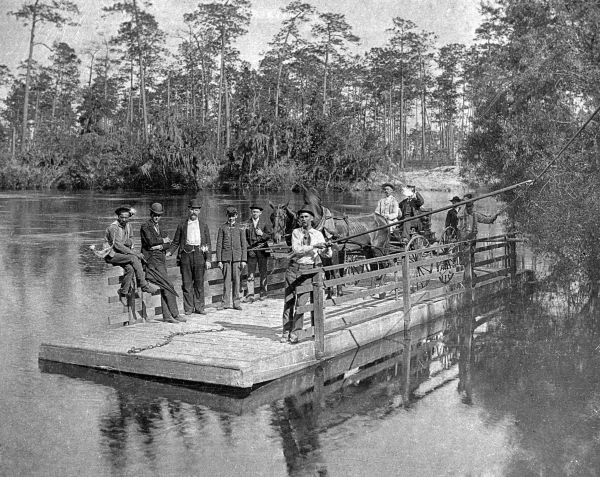
Army ferry use differed in practical ways from civilian ferry travel. A civilian operator generally served whoever arrived and paid the fare, one traveler or wagon at a time. An Army crossing had to move an entire column of soldiers, wagons, and animals across a river as quickly as possible, often under risk of attack from the opposite bank.
That vulnerability is exactly what Clinch's four-or-five-at-a-time canoe crossing exposed at the Withlacoochee. A formally scouted, reliable ferry point such as Livingston's or Charles Ferry was therefore a strategic asset, not merely a convenience.
Why This Mattered for Florida
Army ferries represent a lesson Florida's military commanders learned through costly failure: a river crossing left to chance could stall an entire campaign and hand the tactical advantage to an opposing force. The later reliance on formally designated crossings shows how Florida's military transportation system matured during the Second Seminole War, moving from improvisation toward deliberate planning.
Did You Know?
- Clinch's force had no boats or rafts when it reached the flooded Withlacoochee River in December 1835.
- His soldiers crossed four or five at a time in a single canoe.
- The Army's 1839 operations memoir names Livingston's Ferry and Charles Ferry as designated crossings on the Suwannee River.
Vocabulary
- Ford — a shallow place in a river where it can be crossed on foot, horseback, or by wagon.
- Column — a body of troops moving together in a long formation.
- Logistician — a military planner responsible for the movement and supply of troops.
Discussion Questions
- Why might a slow, improvised crossing have been especially dangerous for an army trying to achieve surprise?
- How did the Army's later reliance on designated ferry crossings reflect lessons learned from earlier failures?
Quick Facts: Army Ferries
| Battle of Withlacoochee | December 31, 1835 |
|---|---|
| Clinch's force size | About 750 regulars and militia |
| Method used to cross the flooded river | Single canoe, 4–5 soldiers at a time |
| Livingston's Ferry | Suwannee River, 5 miles south of the Upper Withlacoochee junction |
| Charles Ferry | Suwannee River, 10 miles south of Livingston's Ferry |
| Gaines's later Withlacoochee standoff | More than a week |
Related Articles on Florida Learning Hub
Sources & Further Reading
- American Military History. “American Military Strategy in the Second Seminole War.”
- NatureCoaster.com. “History Along the Withlacoochee River: The Second Seminole War.”
- Seminole Wars Historic Foundation. “Thomas B. Linnard: Memoir to Accompany Map of Military Operations in Florida.”
- Florida Memory, State Archives of Florida. “Irvine's Ferry on the Suwannee River — Luraville, Florida,” Image RC03145.