The Battle of Natural Bridge
Florida's Only Major Land Battle of the Civil War
Every fort discussed so far in this pillar's Coastal Defense section tells a story of walls, garrisons, and, in most cases, no direct combat at all. The Battle of Natural Bridge, fought March 6, 1865, offers something genuinely different: an actual pitched land battle, the largest fought entirely within Florida during the Civil War, contesting a river crossing roughly twenty miles south of Tallahassee.
This article replaces the originally planned closing piece of Fort Pillar IV, since that topic risked substantial overlap with this pillar's earlier coverage of the Castillo de San Marcos. It turns instead to Florida's most significant Civil War land engagement, connecting directly to Fort San Marcos de Apalache and the outpost network already covered in Fort Pillar II.
A Union Force Aims for the Capital
By early 1865, with the Confederacy collapsing across most of the South, Union forces controlled much of Florida's coastline but had never captured Tallahassee, Florida's state capital and, by that point, the only Confederate state capital east of the Mississippi River still in Southern hands. Union Brigadier General John Newton led an expedition of roughly nine hundred to one thousand troops, including the 2nd and 99th Regiments of the United States Colored Infantry, landing near the St. Marks Lighthouse on March 5 with the goal of reaching and capturing Tallahassee itself.
The Union advance ran into difficulty almost immediately. Naval vessels supporting the expedition could not navigate the shallow St. Marks River to reach San Marcos de Apalache, the fort discussed in this pillar's earlier Spanish Watchtowers article, and the Army force found the bridge at Newport already destroyed by retreating Confederate defenders. Newton ordered a night march to attempt a crossing further upriver, at a natural limestone formation where the St. Marks River briefly ran underground before resurfacing — the Natural Bridge that gave the coming battle its name.
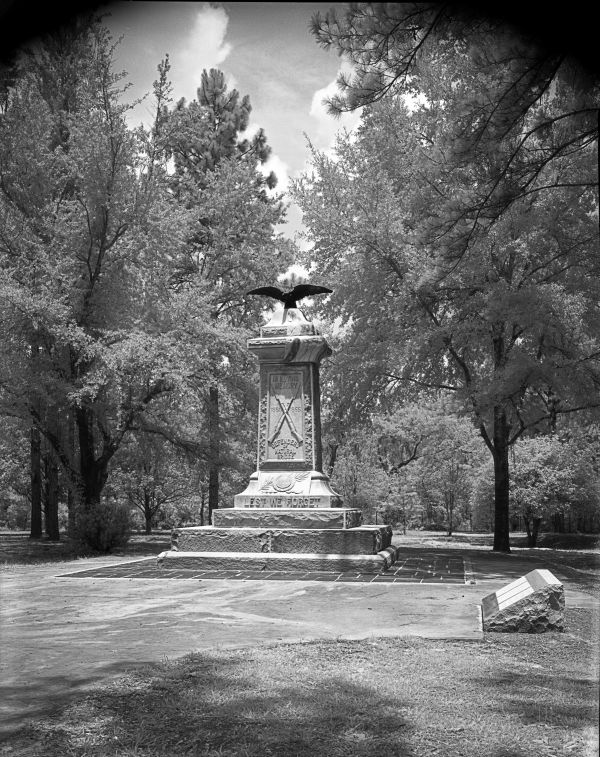
A Hastily Assembled Line Holds
Confederate scouts detected the Union movement and gave Tallahassee's defenders time to react. Brigadier General William Miller, and later Brigadier General Samuel Jones, assembled a genuinely improvised defensive force at Natural Bridge: regular Florida cavalry and artillery units, supplemented by home guard militia, older reserve troops, and a company of roughly twenty-five to thirty teenage cadets from the Florida Military and Collegiate Institute in Tallahassee, an institution that later became Florida State University. The cadets, some as young as fourteen, were formally sworn into Confederate service at the state capitol on March 5, the day before the battle, and were assigned to hold earthworks near the center of the defensive line.
The battle itself unfolded over roughly ten hours on March 6. Confederate forces, protected by breastworks and supported by six artillery pieces against the Union's three, repelled repeated Union attempts to force a crossing at the bridge. By afternoon, with mounting casualties and no success in breaking the Confederate line, General Newton ordered a withdrawal back toward the coast. Confederate reports listed around twenty-five to twenty-six casualties; Union losses were reported considerably higher, with some accounts placing them near one hundred fifty killed, wounded, or missing, though these figures vary somewhat between sources.
A Sober Note Amid the Record
Not every part of the historical record from this engagement reflects well on either side. At least one contemporary account describes two captured men, identified as Captain William Strickland and Private John R. Brannon, being executed by Confederate forces after capture, on accusations of arson — a documented event this article notes factually, as part of an honest historical record, rather than a detail to be glossed over in an otherwise straightforward battle narrative.
Why This Mattered for Florida
The Battle of Natural Bridge secured a genuinely narrow but real strategic outcome: Tallahassee remained under Confederate control until the general Confederate surrender in May 1865, making Florida's capital the only one east of the Mississippi River that Union forces never occupied during the war. Understanding this battle alongside the coastal forts covered earlier in this pillar completes a fuller picture of Florida's Civil War experience — not only a story of forts held or lost along the coastline, but of a single, hard-fought land engagement that determined whether the state's own capital would fall before the war's final end.
Did You Know?
- The Natural Bridge itself is a real geological feature: a quarter-mile stretch where the St. Marks River flows underground before resurfacing.
- Teenage cadets as young as 14 from the future Florida State University were formally sworn into Confederate service the day before the battle.
- The 2nd and 99th Regiments of the United States Colored Infantry were among the Union troops who fought in this battle.
Vocabulary
- Breastworks — a low, temporary defensive wall, often built quickly from earth or logs during a battle.
- Reserves — older or previously exempted soldiers called into military service during times of genuine emergency.
- Flotilla — a small fleet of ships, especially one organized for a specific naval operation.
Discussion Questions
- Why might a genuinely improvised defensive force — cadets, home guards, and regular soldiers together — have been able to hold their position for ten hours against a larger, more organized Union force?
- What does the reported execution of two captured men add to a full and honest understanding of this battle?
Quick Facts: The Battle of Natural Bridge
| Battle date | March 6, 1865 |
|---|---|
| Union force size | About 900–1,000 troops, including U.S. Colored Infantry regiments |
| Confederate force size | About 500–700 troops, militia, and cadets |
| Confederate casualties (reported) | About 25–26 |
| Union casualties (reported) | Roughly 150, per some accounts (figures vary by source) |
| Strategic outcome | Tallahassee remained the only Confederate state capital east of the Mississippi never captured |
Related Articles on Florida Learning Hub
Sources & Further Reading
- Florida State Parks. “Historic Battlefield at Natural Bridge.” floridastateparks.org.
- American Battlefield Trust. “Natural Bridge Battle Facts and Summary.” battlefields.org.
- Museum of Florida History. “The Battle of Natural Bridge.” museumoffloridahistory.com.
- Wikipedia. “Battle of Natural Bridge” and “Natural Bridge Battlefield Historic State Park.”
- Florida Memory, State Archives of Florida. “Natural Bridge Battlefield Historic State Park Monument in Leon County, Florida.” floridamemory.com.