
Birds Before the Storm
How Birds Respond to Changing Weather—and Why Their Responses Vary
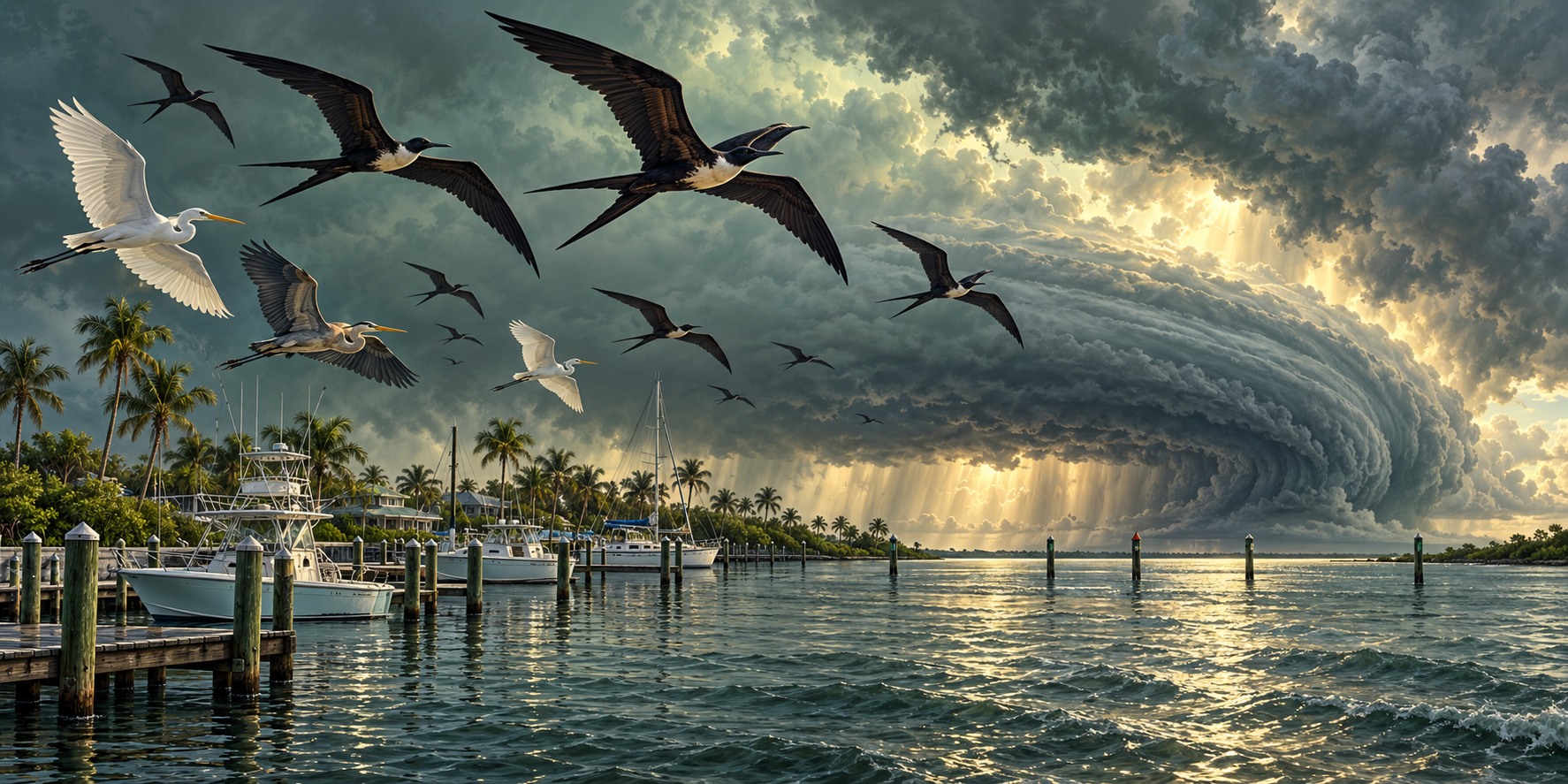
Birds can respond to changing weather before a storm reaches land, but an unusual flock at a marina is not proof that it detected a hurricane from a particular distance. Some birds move, some shelter and some are displaced by wind. Understanding those differences requires observations and tracking, rather than one dramatic sighting.
What the Warbler Study Actually Found
A Current Biology study followed golden-winged warblers in Tennessee during an April 2014 tornado-producing storm system. Tracked birds made a journey of more than 1,500 kilometers over five days. The authors proposed infrasound as a possible warning signal. This was not a hurricane study, and the distance traveled was not a demonstrated hurricane-detection range.
Different Birds, Different Responses
A bird’s response depends on its species, condition and location. Strong fliers may move away from severe weather, while other birds find sheltered places. There is no established rule that Florida birds all leave perpendicular to a hurricane’s track or that one direction is always the most efficient escape.
Feeding Before the Storm, Sheltering Through It
Sanibel-Captiva Conservation Foundation describes birds responding to changes in pressure and wind and using different strategies around hurricanes. Feeding opportunities and shelter matter alongside movement. A bird that remains nearby may be using cover rather than ignoring the storm.
Displacement Far From Home
Storm winds can carry birds far beyond their usual range. In 2023, Hurricane Idalia displaced American flamingos to places far from their normal populations, an example discussed in UF’s wildlife review. Such sightings document displacement; they do not establish that the birds intentionally rode a storm’s eye.
Fallout: A Birdwatcher’s Spectacle, a Bird’s Emergency
Birdwatchers use “fallout” for exhausted birds forced to land during difficult migration conditions. A concentrated gathering can be remarkable to see while also indicating stress. Observers should give resting birds space rather than turning an unusual sighting into another disturbance.
The Danger That Outlasts the Wind
The longer threat is food. Hurricanes destroy vegetation and decimate the insects many birds eat, while shorebirds and wading birds struggle to find fish and invertebrates in flooded, altered coastal habitat. A bird that evacuates, shelters or survives displacement may return to a landscape that no longer reliably feeds it.
Quick Facts
| What birds detect | Weather signals vary; infrasound was proposed in a tornado-storm study |
|---|---|
| Shelter in place | Sheltered cover is one strategy; responses differ by species |
| Biggest long-term risk | Habitat and food losses can persist after the wind |
Did You Know?
The well-known warbler study concerned a tornado-producing storm, not a hurricane.
Hurricane winds can displace birds far beyond their usual range.
Vocabulary
Infrasound: sound at frequencies too low for humans to hear.
Fallout: a sudden grounding of many exhausted birds in one place.
Pelagic: living mostly over the open ocean.
Discussion Questions
1. What signals might birds use to sense a hurricane before people can?
2. Why is a post-storm food shortage such a danger to birds?
Related Articles
FLH-0012 — Hurricane Ian (2022)
FLH-0020 — How Florida Pioneers Predicted Storms
FLH-0040 — What Hurricanes Do to Florida’s Wildlife
FLH-0042 — The Everglades After a Hurricane
Sources
Sanibel-Captiva Conservation Foundation. “Where Do Birds Go During Hurricanes?” sccf.org
USGS — Tornadic storm avoidance behavior in breeding songbirds
UF — Wildlife movement and displacement