Enoch Daniel Jr.
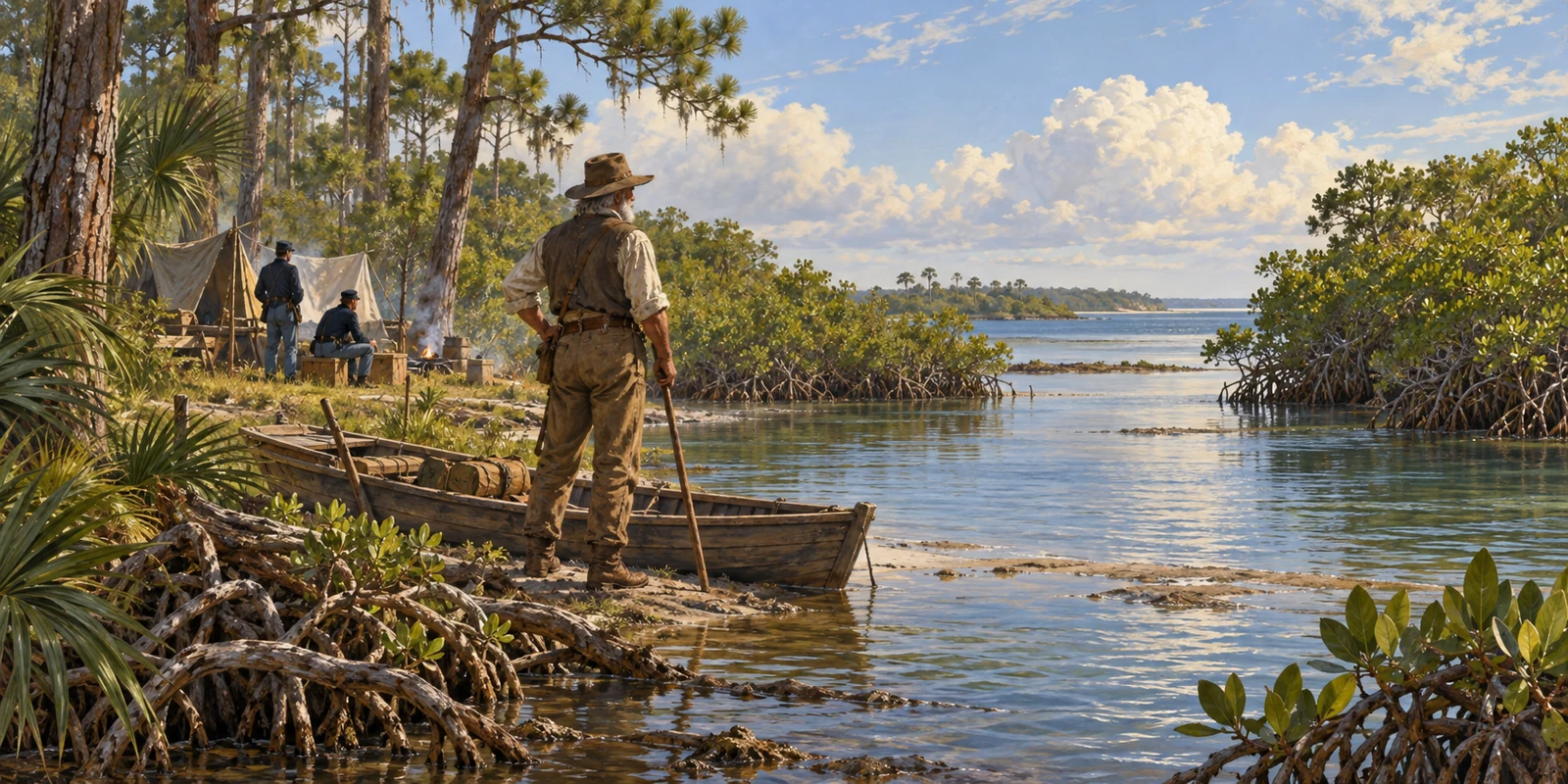
Scout, Soldier, and Unionist of the Charlotte Harbor Frontier
The Second Enoch
In 1830, the federal census taker in Alachua County, Florida Territory, recorded two households sharing the same name: “Daniel, Enoch, Sr.” and “Daniel, Enoch, Jr.” The elder man had been in Florida since at least 1813. The younger man — born about 1800 — had grown to adulthood on that same frontier and was already the head of his own household.
Where his father's story belongs to Spanish East Florida, Enoch Jr.'s belongs to the frontier that followed: the Seminole Wars, the cattle country of the interior, and a Civil War fought along Florida's southwest coast.
Growing Up on the Alachua Frontier
Enoch Jr.'s childhood unfolded during the Patriot War and its unsettled aftermath. An 1818 record naming an “Enoch Daniel” alongside Abraham Daniel and members of the Dell family near the St. Marys River may refer to the younger Enoch, who would have been about seventeen or eighteen. The surviving evidence does not establish whether that reference was to father or son.
By 1830, however, the census clearly establishes Enoch Jr. as a separate adult head of household in Alachua County. A December 25, 1830 petition preserved in the Territorial Papers of the United States also lists an Enoch Daniel among Alachua County residents, although it does not distinguish Sr. from Jr.
The Third Seminole War, 1856
A federal military record documents an Enoch Daniel serving from May 30 through July 20, 1856, with Whitsmith's command during the Third Seminole War period. Because Enoch Sr. would have been in his nineties by then, the manuscript attributes this service with confidence to Enoch Jr.
The record places him among the citizen-soldiers and militia volunteers operating during Florida's third Seminole conflict, a war characterized by patrols, pursuit, and sustained pressure against the remaining Seminole communities of the southern interior.
Southward to Charlotte Harbor
Sometime between his 1856 service and the opening years of the Civil War, Enoch Jr. moved south from the Alachua interior to the Charlotte Harbor region. This was open-range cattle country, with scattered homesteads and a population whose political loyalties did not uniformly follow the Confederacy.
During the Civil War, the Gulf coast south of Tampa Bay became a contested landscape. Confederate cattle drives moved north to supply Southern armies, while Union sympathizers, escaped enslaved people, and men avoiding Confederate conscription gathered along the coast and barrier islands. Enoch Daniel Jr. placed himself on the Union side of that divide.
Organizing the Florida Rangers
By late 1863, Enoch Jr. was organizing a Unionist militia known as the Florida Rangers around Charlotte Harbor. In December 1863, he traveled to Union-held Key West seeking Federal support for the Rangers and the broader Unionist refugee population along Florida's southwest coast.
Scout and Guide
Contemporary Federal records describe Enoch Daniel Jr. as an experienced scout. He led operations inland from Charlotte Harbor and Useppa Island, a Union refuge and staging point during the war. His knowledge of Florida's interior country made him valuable to Federal forces operating in unfamiliar terrain.
A report dated January 2, 1864, survives in Enoch Daniel Jr.'s own hand. That makes the document an unusually direct link to a Florida frontiersman who otherwise appears primarily through census, military, and government records.
Family and the Line to the McMullens
Genealogical proof records document a direct line from Enoch Jr. through his daughter Rebecca Elizabeth Daniels Waterson, her son Robert James Waterson, his daughter Alice Jane Waterson McMullen, her son William Eli McMullen Sr., and William Eli McMullen II.
Enoch Jr. therefore forms the hinge between the Daniel family's early Alachua frontier story and the later Waterson and McMullen lines. The man who served during the Third Seminole War and scouted for the Union at Charlotte Harbor was also a direct ancestor in the family line that later reached Pinellas County.
Legacy
Enoch Daniel Jr.'s Florida life was shaped by frontier conflict from childhood through old age: the aftermath of the Patriot War, the Alachua frontier, service during the Third Seminole War, and Unionist activity during the Civil War. His documentary trail spans nearly five decades of a rapidly changing Florida.
Enoch Daniel Sr. brought the family into Florida while it was still Spanish territory. Enoch Daniel Jr. carried that inheritance through territorial Florida and into the Civil War era, helping continue the family line that eventually became part of the McMullen story.
Did You Know?
- Enoch Daniel Sr. and Jr. appear as separate heads of household in the 1830 Alachua County census.
- Enoch Jr. served during the Third Seminole War period in 1856.
- By the Civil War he was organizing Unionist activity around Charlotte Harbor.
- A January 2, 1864 report attributed to Enoch Jr. survives in his own hand.
Vocabulary
- Unionist — a person who remained loyal to the United States during the Civil War.
- Scout — a person who used local knowledge to guide military forces and gather information.
- Charlotte Harbor — the large estuary on Florida's southwest Gulf coast that became an important Civil War operating area.
Discussion Questions
- Why would Enoch Jr.'s knowledge of frontier Florida have been valuable to Federal forces?
- What does his Unionist activity reveal about political loyalties in Civil War Florida?
- Why is a report written in Enoch Jr.'s own hand especially valuable to historians?
Quick Facts
| Born | About 1800 |
|---|---|
| 1830 | Head of household, Alachua County |
| 1856 | Military service during Third Seminole War period |
| 1863–1864 | Florida Rangers / Unionist activity, Charlotte Harbor |
| January 2, 1864 | Field report attributed to Enoch Daniel Jr. |
Sources & Further Reading
- 1830 U.S. Federal Census, Florida Territory, Alachua County.
- Territorial Papers of the United States, Florida Territory, Vol. 24, pp. 284–286.
- Federal military record for Enoch Daniel, May 30–July 20, 1856, Whitsmith's command.
- Florida Rangers organizational records and correspondence, Charlotte Harbor/Useppa Island, 1863–1864.
- Search for Yesterday: A History of Levy County, Florida.
- Toni Collins, “Seeking Lost Relatives,” Cedar Key News.
- Complete Florida Family Lineage and Proof Record, Daniels–Waterson–Platt–McMullen.