The McMullen-Coachman Log Cabin
The House That Helped Build Pinellas
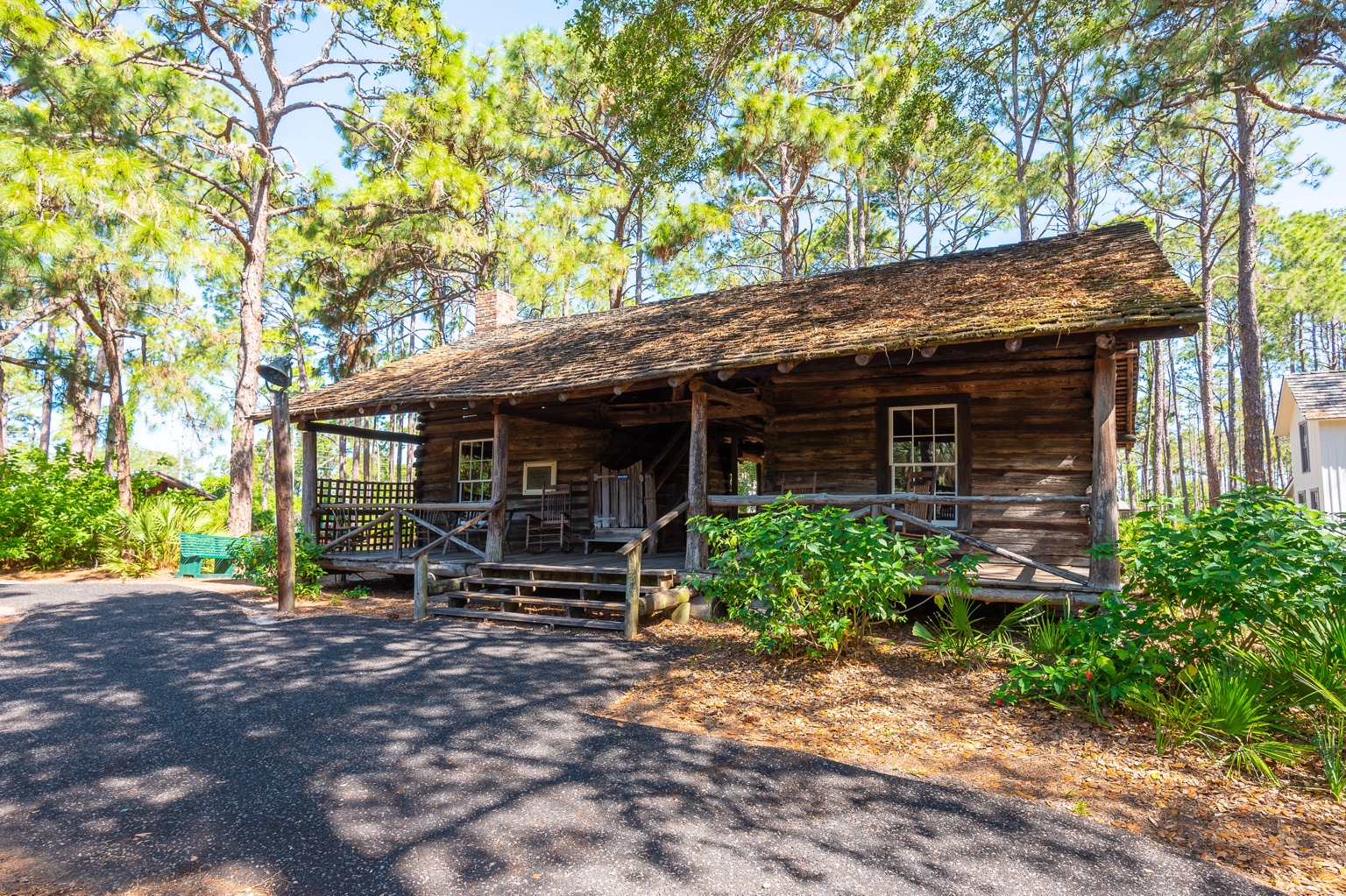
More Than an Old Log House
At Heritage Village in Largo stands a weathered log house whose rough-hewn walls reach back to the years when the Pinellas Peninsula was still a thinly settled frontier. Today roads, neighborhoods, schools, businesses, and cities cover the peninsula. In the middle of that modern landscape, the McMullen-Coachman Log Cabin survives as a physical witness to the people who lived here before those things existed.
It is usually introduced as the oldest surviving structure in Pinellas County and as an example of the dogtrot, or double-pen, log-house tradition. Both descriptions are important. Neither is large enough to contain its story.
For the McMullen family, the cabin was a home and the center of a working frontier homestead. Cattle, crops, sugar cane, citrus, children, travelers, music, illness, childbirth, war, and community life all touched the place. Elizabeth Campbell McMullen became known for assisting women in childbirth, and historical interpretation associated with Heritage Village reports that nearly sixty McMullen-family children were born in the cabin before 1900. The homestead was connected to the beginnings of formal schooling on the peninsula and to the primitive routes that eventually became part of Pinellas County's road network.
For the Coachman family, who acquired the property at the beginning of the twentieth century, the old house became both useful property and something worth saving. Their stewardship helped carry it through modernization, public interest, neglect, fire, and finally preservation. In 1977 the Coachman family donated the damaged structure to Heritage Village, where it was restored and opened to the public.
The result is unusual: a nineteenth-century frontier house that survived long enough for twenty-first-century Floridians to walk through its breezeway and stand inside rooms connected to some of the earliest documented community life on the Pinellas Peninsula.
A House Designed for Florida
The McMullen-Coachman house belongs to a Southern log-building tradition commonly called the dogtrot. In its simplest form, two enclosed log pens stand several feet apart beneath one continuous roof. The open passage between them—the dogtrot or breezeway—is not leftover space. In a hot climate it is the organizing feature of the house.
Air moving through the open center provided relief before electric fans and air conditioning. The covered passage also created shaded working and living space. Meals could be prepared or eaten nearby, children could play out of the direct sun, chores could be done under cover, and people could sit where whatever breeze was moving had the best chance of reaching them.
Heritage Village describes the McMullen-Coachman Cabin as a Georgia-style log cabin made from local timber, including pine and cypress. Its first floor consists of two rooms divided by the central dogtrot, and the building also had an upper level with its own passage. The logs, fireplaces, small openings, broad porch, and open center demonstrate how settlers adapted familiar building practices to the heat, rainfall, insects, and available materials of Florida.
The exact construction date deserves a historian's caution. Heritage Village generally dates the house to 1852, and that is the date most often used in public interpretation. Detailed historical research, however, notes that family accounts and printed sources have placed construction between 1848 and 1852. Florida Learning Hub therefore uses "circa 1852" while recognizing that the surviving evidence does not establish a single uncontested year.
James and Elizabeth McMullen
Captain James Parramore McMullen and Elizabeth Campbell McMullen were the cabin's first occupants. James was one of the seven McMullen brothers whose movement into the Tampa Bay region became part of the pioneer history of the Pinellas Peninsula. He and Elizabeth married in 1844. By the late 1840s and early 1850s, their lives were increasingly tied to the land near Alligator Creek in what is now the Clearwater area.
The McMullen homestead encompassed roughly 240 acres. Heritage Village interpretation describes a diversified operation that included cattle, sugar cane, citrus, and other crops. That diversity mattered. Frontier families rarely depended upon a single source of food or income, and the McMullens' activities eventually connected the homestead to the larger cattle and agricultural economy of Tampa Bay.
James's documented public life extended beyond farming. Records place him in Florida military service during the Third Seminole War era, and an 1861 Florida roster identifies a company commanded by Captain James P. McMullen and stationed at Clearwater Harbor. Later historical and Heritage Village research also connects James and his brother Daniel with the wartime cattle-supply system remembered as the Confederate "Cow Cavalry." Because surviving military records and later accounts do not always use McMullen initials consistently, Florida Learning Hub treats the detailed Cow Cavalry record with appropriate source caution while recognizing the substantial local archival evidence connecting James to cattle drives and wartime supply work.
That distinction matters. The cabin's history is strong enough without turning uncertain details into certainties. Where the record is firm, it should be stated firmly; where the evidence is complicated, the complication belongs in the history.
Elizabeth McMullen and a Frontier 'Hospital'
The story of the cabin cannot be told as James McMullen's story alone. Elizabeth Campbell McMullen occupied a role that made the house important to families far beyond her own.
Heritage Village materials identify Elizabeth as an early—probably the first—midwife in the area. In a sparsely settled community without a nearby hospital, physician, paved road, ambulance, or modern communications, an experienced woman who could assist during childbirth was indispensable. Women came to the McMullen home, and children were delivered there. Historical interpretation associated with the site reports that nearly sixty members of the extended McMullen family alone were born in the cabin before 1900.
That helps explain why Heritage Village educational material describes the home as the area's earliest "hospital." The word should not be read as though the cabin contained a nineteenth-century medical institution. It describes a community function: when people needed help, this was one of the places they came.
The distinction makes the story more powerful, not less. A frontier hospital could be a log house, a bed, clean cloth, water carried by hand, practical knowledge, and a woman willing to help another family through a dangerous night.
A House Where the Community Gathered
For roughly two decades, historical accounts describe the McMullen home as one of the most substantial houses in upper Tampa Bay. Its importance made it a natural stopping place for people traveling overland. Before railroads and a mature road system crossed Pinellas, travel could be slow, uncertain, and exhausting. A known household offered water, food, news, shelter, and human company.
Heritage Village interpretation remembers the cabin as a favorite stop where visitors could spend an evening with the family and where music—guitar, fiddle, and organ—accompanied dancing. That image is important because pioneer history can easily become a catalogue of hardship. The people who built early Pinellas also made music, visited neighbors, celebrated, courted, raised children, and created community.
The McMullen cabin was therefore not simply where one family slept. It was one of the places where an emerging community met itself.
The First School: What the Evidence Actually Says
James McMullen is also credited with helping establish the first formal school on the Pinellas Peninsula. A 1940 historical sketch preserved by the State Archives of Florida states that the first school on the peninsula was held in a log cabin built by Captain James P. McMullen at his home near Coachman.
More detailed local research adds an important qualification. It describes the earliest classes as meeting in the upper floor or attic of a sugarhouse on the McMullen property, where James constructed benches and a teacher's desk. As attendance increased, James McMullen and neighbor Richard "Dick" Booth helped construct a separate one-room log school nearby, remembered as the McMullen Log School or Sylvan Abbey.
These accounts are not necessarily contradictory. The phrase "at his home" can describe the McMullen homestead rather than the surviving residential cabin itself. Until stronger evidence establishes that classes were held on the second floor of the McMullen-Coachman residence, Florida Learning Hub does not make that claim. What can be said confidently is that the McMullen property and James McMullen were central to the beginning of formal education on the peninsula.
From a Trail Between Neighbors to McMullen-Booth Road
The same neighbor who appears in the school story appears in another piece of Pinellas history. James McMullen and Richard "Dick" Booth are traditionally credited with cutting or improving an early route between their properties. Historical accounts later connect their work with the route that became McMullen-Booth Road.
The modern road bears little resemblance to a hand-cut pioneer trail, but the continuity of the name is significant. The story places the McMullen homestead within the earliest transportation geography of the peninsula: houses first, paths between them, then roads, railroads, towns, and eventually the heavily developed county visible today.
Florida Learning Hub treats the road's fuller history separately. Here its importance is simpler: the cabin stood in a landscape that was not merely being occupied. It was being connected.
Cattle, Sugar, Citrus—and a Changing Peninsula
Cattle were part of the McMullen family's economy and part of a much older Florida story. Long before the western cattle drive became an American icon, Florida cattle were being gathered, driven, traded, shipped, and exported. The McMullens participated in that world. Historical accounts connect their cattle with markets elsewhere in the South and with Cuba, whose trade became especially important to Florida cattlemen.
The homestead also changed with the agricultural economy. Sugar cane was grown and processed, and by the postwar years the family manufactured syrup barrels and held cane-grinding gatherings. Citrus later became increasingly important. The transition from open-range cattle and mixed subsistence agriculture toward groves, packing, rail shipment, and commercial development can be traced through the history of this one property.
That is one reason the cabin matters so much. It survived long enough to witness several versions of Florida: frontier settlement, cattle country, Civil War and Reconstruction, the citrus economy, railroad development, county formation, automobile roads, and twentieth-century growth.
The Coachman Family Takes Over
At the beginning of the twentieth century the property's story entered a new chapter. Solomon and Jessie Coachman purchased the McMullen homestead, including the cabin and approximately 240 acres, for $8,100. Sources differ slightly on whether the transfer and occupancy should be dated 1901 or 1902; the deed-era story is generally presented as a 1902 purchase.
The Coachmans did not freeze the cabin in time. They modernized it. Glass was added to openings that previously relied on shutters, gaps between the logs were sealed, and additions made the old structure more useful to a twentieth-century family and business operation.
Solomon Coachman's interests included citrus, a sawmill, a general store, and civic affairs. He became an important participant in the movement to create Pinellas County from western Hillsborough County and in 1912 became the first chairman of the newly created Pinellas County Board of County Commissioners. The old log house thus remained connected to public life long after its frontier years.
Jessie Coachman's contribution was equally important to the building's survival. She recognized that the cabin was more than obsolete real estate. By the 1930s the family had recovered original furnishings with assistance from McMullen descendants, and the Clearwater chapter of the Daughters of the American Revolution dedicated the cabin as a historic structure in 1936. Visitors were welcomed and told about early life on the peninsula.
Fire, Donation, and a Second Life
Preservation was not inevitable. By the later twentieth century the cabin had again fallen out of regular public use and was at times used for storage. Then, in November 1976, an arsonist set a series of fires on the Coachman estate. The McMullen-Coachman Cabin was badly damaged, and much of its second floor was destroyed.
A building that had survived frontier Florida, war, hurricanes, agricultural change, and nearly a century and a quarter of development could easily have ended there.
Instead, the Coachman family donated the structure to Heritage Village in 1977. The building was moved, restoration followed, and it opened to the public at Heritage Village in 1979. Its modern name properly honors both families: the McMullens who built and inhabited the frontier homestead, and the Coachmans whose ownership and preservation efforts helped carry the building into an era when professional public history could protect it.
Why Heritage Village Matters
Historic buildings do not preserve themselves. Florida's climate is hard on wood. Fire, termites, hurricanes, land development, road construction, changing property values, and simple neglect have erased countless structures that once looked as ordinary to their owners as a modern house does today.
Heritage Village gives the McMullen-Coachman Cabin something its builders could never have imagined: a protected setting where future generations can study it as evidence. Visitors can see the scale of the rooms, the central passage, the logs, the fireplaces, and the relationship between indoor and outdoor space. A paragraph can explain a dogtrot. Walking through one teaches something different.
The Village also preserves context. Nearby historic buildings—including the later Daniel McMullen House—allow visitors to see how construction, transportation, agriculture, commerce, and domestic life changed as Pinellas moved from a frontier peninsula toward the twentieth century.
That preservation work is why the cabin is not merely a story in an old newspaper or a photograph in an archive. It is still a place.
What the Cabin Can Tell Us
The McMullen-Coachman Log Cabin is important because it compresses an extraordinary amount of Pinellas history into one surviving structure.
• Its dogtrot construction shows how settlers adapted buildings to Florida's climate.
• Its McMullen years connect the site to cattle, crops, sugar, citrus, military service, early transportation, and frontier community life.
• Elizabeth McMullen's work as a midwife connects the cabin to childbirth and community care when formal medical services were distant or nonexistent.
• The McMullen homestead connects directly to the beginnings of formal schooling on the Pinellas Peninsula.
• The James McMullen–Richard Booth tradition connects the homestead to the route remembered today in the name McMullen-Booth Road.
• The Coachman years connect the building to citrus, business, the creation of Pinellas County, historic preservation, and the transformation of the peninsula.
• Its survival after the 1976 fire demonstrates how easily historic structures can be lost—and how deliberate preservation can save them.
The House That Helped Build Pinellas
There is a temptation to look at an old cabin and see simplicity: rough logs, small rooms, an open breezeway, a fireplace. But simplicity is not the same as insignificance.
Inside and around this house, a family raised children and cattle, planted crops, helped neighbors through childbirth, received travelers, made music, participated in war and recovery, supported education, and watched paths become roads. A second family carried the house into a new century, participated in the creation of Pinellas County, recognized the building's historical value, and ultimately helped place it in public hands.
Today the McMullen-Coachman Log Cabin stands at Heritage Village because generations of people decided—sometimes at the last possible moment—that it was worth keeping.
Before there were highways and subdivisions, there were places like this.
Research Notes
Construction date: Heritage Village generally uses 1852. Detailed local research identifies competing dates from 1848 through 1852. This article therefore uses “circa 1852.”
First school: State archival material places the first school at Captain James P. McMullen's home near Coachman. More detailed local research identifies the upper level/attic of a sugarhouse on the McMullen property as the first classroom, followed by a separate school building. This article does not claim that the second floor of the surviving residence was the classroom.
Civil War cattle service: Heritage Village and detailed local historical research connect James and Daniel McMullen with the Confederate cattle-supply system known as the Cow Cavalry. Because surviving military records and later transcriptions contain inconsistent initials, the article avoids assigning unsupported unit details to James P. McMullen.
Related Articles on Florida Learning Hub
• What Is a Dogtrot Cabin? (FLH-0002 Mini) — the general architecture and climate design behind the dogtrot tradition this cabin belongs to
• Captain Jim McMullen and the Pinellas Peninsula (FLH-0306) — the fuller biography of the cabin's builder, including his 1861 military captaincy and Cow Cavalry service
• The Seven McMullen Brothers of Pinellas (FLH-0307) — family context, including brother Daniel McMullen's separate log house, also preserved and distinct from this cabin
• Before Texas: Florida's First Cattle Empire (FLH-0305) — the centuries-deep roots of the open-range cattle economy the McMullen homestead was part of
• Jacob Summerlin: The Rise of Florida's Cattle Kingdom (FLH-0044) — a contemporary cattle figure whose career paralleled the McMullen family's in scale and era
Sources & Further Reading
• Heritage Village Museum & Park, Pinellas County Government. Educational Group Guide and McMullen-Coachman Log Cabin interpretive materials.
• Heritage Village Library and Archives research materials, summarized in “McMullen-Coachman Log Cabin: A Brief Introduction.”
• Florida Memory, State Archives of Florida. “Historical Sketch of Pinellas County.”
• Harris, Robert C. “The Seven McMullen Brothers of Pinellas County.” Tampa Bay History, Vol. 1, Issue 2 (1979).
• Ivey, Donald J. “The Accidental Pioneer: Capt. Jim McMullen and the Taming of the Pinellas Peninsula.” Sunland Tribune, Vol. 22.
• Pinellas County historical materials concerning the Board of County Commissioners and the Coachman/McMullen families.
• Monica M. Drake, Historical Museum Operations Manager, Heritage Village Museum & Park. Direct correspondence and photograph supplied to Florida Learning Hub, August 2026.
Photograph Credit & Permission
For Teachers and Students
Learning Focus
Explore frontier architecture, the role of family and community, early education, agriculture, civic development, and the preservation of historic places. Consider how historians distinguish documented evidence from family tradition.
Glossary
- Dogtrot
- An open, roofed passage between two enclosed rooms of a log house.
- Homestead
- A family residence and its surrounding land used for daily life, farming, or livestock.
- Midwife
- A person experienced in assisting women during pregnancy and childbirth.
- Frontier
- A region undergoing settlement and development, often with limited infrastructure or public services.
- Sugarhouse
- A building used for processing sugar cane or making syrup; historical research identifies an upper space in one on the McMullen property as an early classroom.
- Preservation
- Protecting and caring for historic buildings, objects, and places so future generations can study them.
- Primary source
- Evidence created during the period being studied, such as an original record, letter, or photograph.
Reflection and Discussion Questions
- How did the dogtrot design help Florida frontier families manage the climate before electricity?
- Why was Elizabeth McMullen’s midwifery work important to the surrounding community?
- Why does the article distinguish between the first school on the McMullen property and the surviving cabin? What can this teach us about interpreting evidence?
- What would the community have lost if the McMullen-Coachman Log Cabin had not been saved after the 1976 fire?
Classroom Activity
Sketch and label a dogtrot cabin and compare it with a present-day Florida home. Then make a short preservation timeline using circa 1852, 1902, 1936, 1976, 1977, and 1979. Explain why some early dates remain approximate.
Photograph Credit
McMullen-Coachman Log Cabin at Heritage Village Museum & Park, Largo, Florida. Photograph by Monica M. Drake, Historical Museum Operations Manager, Heritage Village Museum & Park, Parks & Conservation Resources, Pinellas County Government. Used with express written permission.