Telegraph Lines and Supply Routes
A New Wire Reaches an Old Fort
When General Braxton Bragg arrived at Fort Barrancas on March 11, 1861, to take command of Confederate forces gathering around Pensacola Bay, he inherited a difficult problem: how to coordinate a growing army with commanders and government officials hundreds of miles away in Richmond and Montgomery. A major part of the answer lay in telegraph service that reached Tallahassee and Jacksonville in 1859, shortly before the Civil War. Bragg's surviving correspondence, now preserved at the University of West Florida, documents an active exchange with Confederate leadership throughout the Pensacola standoff.
This article continues Fort Pillar V's exploration of Florida's military roads and transportation, turning to the telegraph — a technology that transformed how forts and armies could coordinate with one another and with the wider world.
A Technology That Arrived Just in Time
The telegraph reached Tallahassee in 1859, according to institutional histories of Florida communication — just two years before secession and only fifteen years after Samuel Morse's 1844 demonstration helped make long-distance electrical communication practical. Earlier Florida forts and military roads had operated entirely without telegraph service, relying on couriers, mail, and messages carried along the same roads and waterways used for physical supply.
The telegraph changed that relationship fundamentally, though only where lines actually reached. During the Civil War, the U.S. Military Telegraph Corps eventually constructed more than fifteen thousand miles of line, while Southern telegraph networks also connected important military and political centers. Telegraph lines frequently followed established transportation corridors, meaning places already connected by road or rail were more likely to gain rapid communication as well.
Coordinating a Siege From Two Hundred Miles Away
The value of rapid communication became clear during the long standoff at Pensacola Bay. Bragg's surviving papers at the University of West Florida include correspondence concerning activities at Pensacola, plans involving Fort Pickens, and communications from Montgomery and Richmond. That record shows that the Confederate command at Pensacola remained in active contact with political and military leaders far beyond Florida.
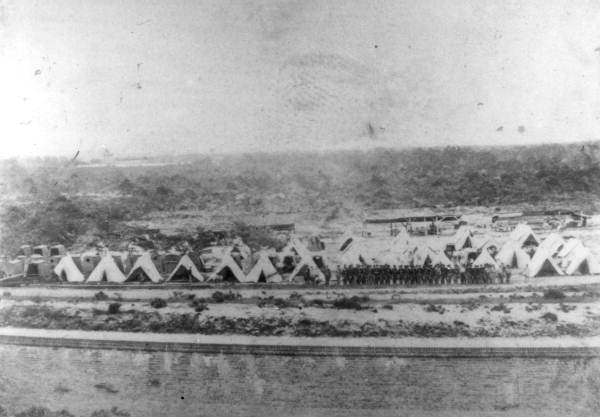
This coordination mattered directly to troop movements and supply decisions. Bragg requested reinforcements from the governors of Alabama, Louisiana, Georgia, and Florida, helping build his force from roughly 1,100 men in late March 1861 to about 5,000 by mid-April. A message that once might have taken days by courier could, where telegraph lines connected the necessary points, travel in hours.
Why This Mattered for Florida
Telegraph lines did not replace roads, railroads, rivers, wagons, or ferries. Ammunition, food, equipment, and soldiers still had to move physically. What the telegraph changed was the speed of the information that told commanders where those people and supplies were needed.
That new layer of communication helped move Florida's military system from the slower frontier world of mounted couriers toward the modern age of near-instant long-distance command.
Did You Know?
- Telegraph service reached Tallahassee and Jacksonville in 1859, shortly before the Civil War.
- The U.S. Military Telegraph Corps operated more than 15,000 miles of military telegraph line during the Civil War.
- General Bragg's surviving Pensacola correspondence documents communication with both Montgomery and Richmond during the 1861 standoff.
Vocabulary
- Telegraph — a system for sending coded electrical signals over wires for rapid long-distance communication.
- Correspondence — an exchange of letters or written messages, especially for official purposes.
- Standoff — a tense confrontation in which opposing sides remain in position without immediately resolving the conflict.
Discussion Questions
- Why did telegraph lines often follow existing roads and railroads?
- How could faster communication change what a military commander could accomplish during a long standoff?
Quick Facts: Telegraph Lines and Supply Routes
| Florida telegraph service reached Tallahassee | 1859 |
|---|---|
| Samuel Morse's famous telegraph demonstration | 1844 |
| U.S. Military Telegraph Corps founded | 1861 |
| Union military telegraph line constructed, 1861–1866 | More than 15,000 miles |
| Bragg's force, late March 1861 | About 1,100 |
| Bragg's force, mid-April 1861 | About 5,000 |
Related Articles on Florida Learning Hub
Sources & Further Reading
- University of South Florida. “Florida Newspaper History Chronology, 1783–2001.”
- University of West Florida Archives and West Florida History Center. Pensacola Civil War collections and Braxton Bragg correspondence.
- American Battlefield Trust. “The War that Almost Started at Pensacola” and “Pensacola (1861) Battle Facts and Summary.”
- Florida Memory, State Archives of Florida. “Confederate Army Camp Behind Fort Barrancas — Pensacola, Florida,” Image RC15637.
- U.S. Military Telegraph Corps historical references.