
Why Some People Stay
The Difficult, Often Misunderstood Decision Florida Families Face Every Hurricane Season
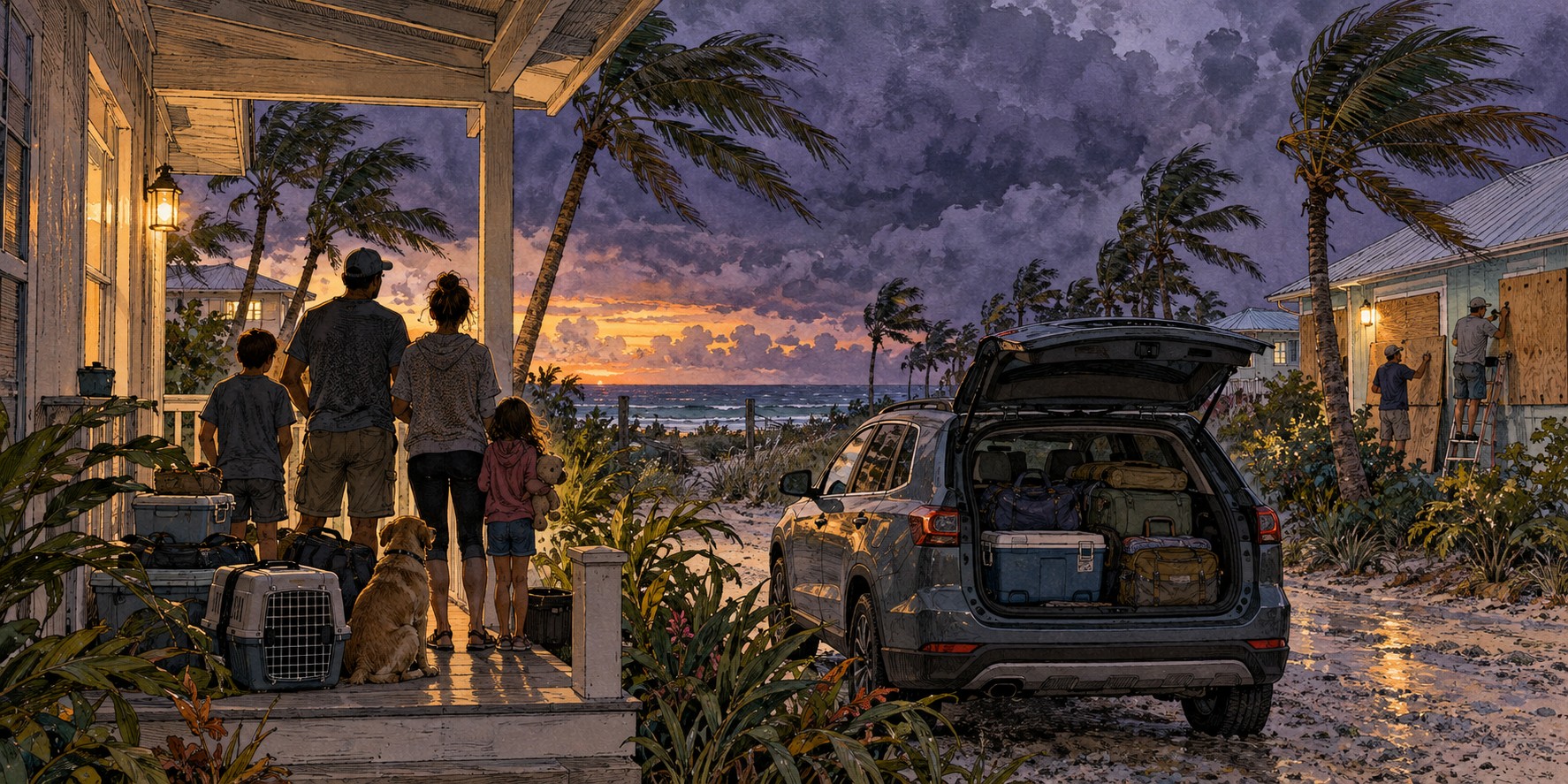
A small white dog named Snowball became one of the defining images of Hurricane Katrina, not because of anything the storm did, but because of what came after. As evacuees boarded buses leaving New Orleans, a police officer took the dog from a young boy’s arms; pets were not allowed aboard. The boy cried until he became physically ill, calling the dog’s name. The reported scene raises a question Florida faces every hurricane season: when officials order an evacuation, why do some people stay anyway? Research after Katrina points to specific, recurring and often deeply rational reasons.
Outside Judgment, Inside Experience
During Katrina, people who stayed were widely portrayed as careless or uninformed. Researchers Nicole Stephens of Stanford and colleagues at Princeton examined that framing in a 2009 study in Psychological Science. Surveying both Katrina survivors and people outside the storm’s path, they found a measurable mismatch: from outside, staying looked irresponsible; from inside, it looked entirely different. Those who stayed were, on average, less financially secure than those who left.
Six Documented Factors
Dr. Stacy Willett of the University of Akron’s Department of Disaster Science and Emergency Services, working in part with FEMA, studied why people ignore mandatory evacuation notices. Her work identified six recurring factors: age, gender, previous experience, cost, pets and the influence of other people.
Older residents may face particular barriers to leaving, because of ingrained habits, medical and mobility limits that make a hurried departure hard, and attachment to records, photographs and heirlooms that cannot be packed into one car in a few hours. Some studies also report differences by gender, though decisions depend on many overlapping circumstances.
What It Costs to Leave
Cost is among the most overlooked barriers. Fuel, lodging at inflated rates and lost wages can add up to hundreds or thousands of dollars. Governments open shelters and sometimes provide free transportation to reach them, but these do not close the gap for every family. For a household without transportation, savings or a destination, staying is not a failure of judgment but a material constraint.
Work adds pressure. Researchers summarized by NPR found that people in auto repair, roofing, remodeling and siding often face employer pressure to be available right after a storm, and some fear losing the job if they cannot get back in. Others see cleanup and repair work as an income opportunity.
The Animals
Concern for pets can be a significant barrier to evacuation. Many separations were forced by evacuation policies that did not account for animals at all.
Congress responded with the Pets Evacuation and Transportation Standards Act, signed October 6, 2006, as an amendment to the Stafford Act. It requires state and local emergency plans to address households with pets and service animals in order to qualify for federal disaster funding, and authorizes FEMA to support rescuing, sheltering and caring for animals. A 2021 ASPCA survey found 91 percent of pet owners now plan to evacuate with their pets, though 47 percent of those with prior evacuation experience reported leaving at least one animal behind.
When the Last Storm Wasn’t So Bad
Researchers describe hurricane fatigue: residents who weathered an earlier storm with limited damage tend to underestimate the next. A related effect works against officials. When an evacuation order proves overly cautious in hindsight, residents grow more skeptical of future warnings, leaving emergency managers to weigh the cost of under-warning against the erosion of public trust.
The Person Next Door
Willett’s final factor is other people. Peer pressure and community norms can sway a household toward staying or leaving more powerfully than official messaging. If most neighbors plan to stay, others feel pressure to do the same; where evacuating is the norm, the pressure runs the other way. Anyone who knows a person in a vulnerable area has real influence, simply by offering a concrete invitation to stay somewhere safer.
For current guidance, rely on your county emergency management office and the National Hurricane Center, not on any single article.
Quick Facts
| Lead researcher | Dr. Stacy Willett, University of Akron, post-Katrina research with FEMA |
|---|---|
| Six factors | Age, gender, previous experience, cost, pets, other people |
| 2009 study | Stephens and colleagues, Psychological Science: outside and inside views of staying differ |
| Cost | Hundreds to thousands of dollars in fuel, lodging and lost wages |
| Katrina pets | Pet care can create practical barriers to evacuation |
| PETS Act | Signed October 6, 2006; ties federal disaster funding to pet-inclusive plans |
| 2021 ASPCA survey | 91% plan to evacuate with pets; 47% of experienced evacuees left one behind |
| Hurricane fatigue | A mild past storm lowers perceived risk from the next |
Did You Know?
Researchers found that those who stayed during Katrina were, on average, less financially secure than those who left.
The PETS Act ties federal disaster funding to plans that include pets and service animals.
Some workers feel pressure to stay because employers expect them to be available right after a storm.
Vocabulary
Mandatory evacuation: an order from local officials that residents in a defined area must leave.
Hurricane fatigue: a lowered sense of risk after earlier storms caused little harm.
Service animal: a dog trained to perform tasks for a person with a disability.
Discussion Questions
Why might the same decision look reckless from outside and reasonable from inside?
Which of the six factors could a community address most directly, and how?
Related Articles
FLH-0018 — The Great Florida Evacuations
FLH-0011 — Hurricane Irma (2017)
FLH-0014 — The Birth of Florida Emergency Management
FLH-0016 — How Hurricane Forecasting Changed Florida
Sources
University of Akron News. “Why Some People Won’t Evacuate: FEMA Research.” uakron.edu
Scripps News. “Why Do Some People Choose to Stay Put During Dangerous Hurricanes?” scrippsnews.com
CNBC. “Why Some People Never Evacuate During a Hurricane, According to a Psychologist.” cnbc.com
PMC / NIH. “Evacuation of Pets During Disasters: A Public Health Intervention to Increase Resilience.” pmc.ncbi.nlm.nih.gov
NPR. “Why People Stay Home When a Hurricane Is Coming.” npr.org
Natural Hazards Center, University of Colorado Boulder. “Evacuation Obstacles.” hazards.colorado.edu
Animal Legal Defense Fund. “The PETS Act.” aldf.org
The Florida Bar. “A Look at the PETS Act and Related Florida Law in the Wake of Hurricane Ian.” floridabar.org
Stephens and colleagues — Katrina observer and survivor study